

A passing gas pressure test does not make a later gas odor safe to ignore. The result applies to the isolated piping, pressure, duration, and setup documented at the time. An excluded appliance, connector, valve, regulator, pilot system, or untested branch may remain outside that scope.
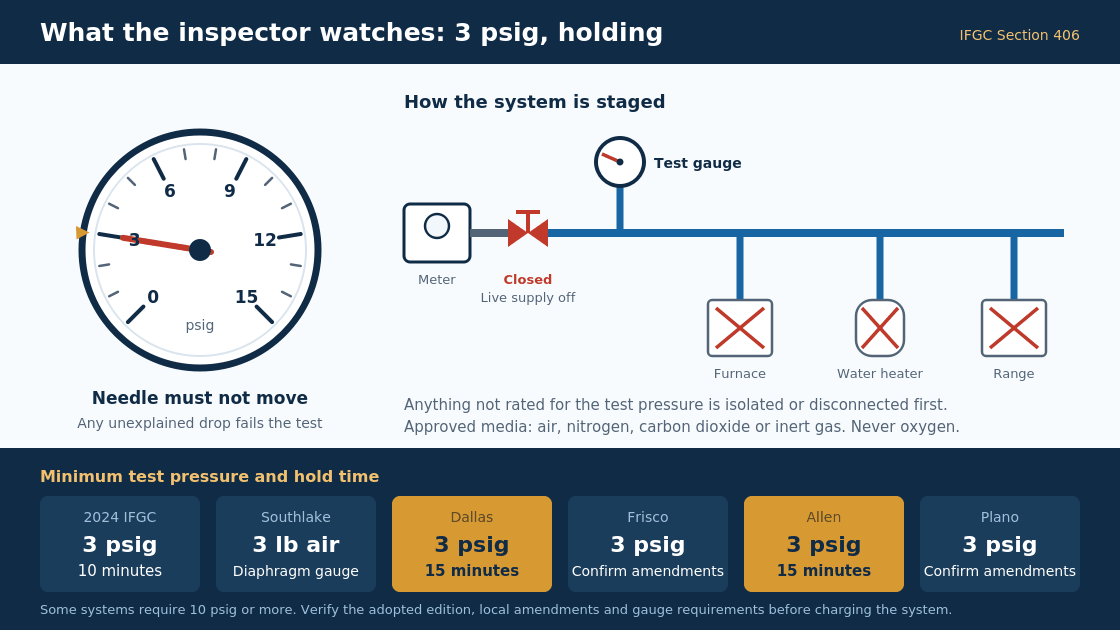
A test result is limited by its setup
The written record should identify the tested piping, excluded equipment, test pressure, stabilization period, duration, gauge, valve positions, and result. A statement that “the line passed” is incomplete if the tested boundaries are not clear.
Appliances and connectors may be excluded
Elevated-pressure testing commonly requires appliances or sensitive controls to be isolated. If a range, furnace, fireplace, water heater, connector, or appliance valve was outside the test, the passing result does not clear it.
Intermittent conditions can change
Temperature, vibration, appliance operation, valve position, regulator behavior, and pressure changes can affect when a problem appears. A system condition that was absent during one test may require a different safe evaluation after the odor returns.
Odor location is not the same as leak location
Gas can move through cabinets, chases, walls, attics, soil, and air currents. Odor may also vary because the odorant concentration and airflow change. An electronic detector samples air at a point; bubbles show leakage only at an accessible joint under the test condition.
Restoration and retesting depend on local process
Repairs, permits, inspection, documentation, and utility restoration differ by city and utility. Plano, Dallas, Allen, Richardson, and other DFW jurisdictions may not use the same sequence. Confirm the current local requirement rather than applying one city’s process everywhere.
What a useful follow-up record includes
Document when the odor returned, which equipment had operated, where people first noticed it, the prior test boundaries, and any utility action. Do not enter the affected area to collect those details during a suspected emergency.
Related gas-safety resources
- Why a disappearing gas odor is not clearance
- What a failed gas pressure test means
- Appliance connector versus house-piping leaks
- Atmos Energy gas-emergency instructions
- Railroad Commission of Texas gas-leak notice
Frequently asked questions
Does a passing pressure test prove there is no gas leak?
It supports that the included piping held under the documented conditions. It does not clear excluded equipment or every future operating condition.
Can an appliance leak after house piping passes?
Yes. Appliances, controls, connectors, and valves may be isolated from the piping test and require separate safe evaluation.
Should I try to identify which appliance smells?
No. Leave immediately and call from a safe distance. Do not operate or move appliances while gas may be present.
Can gas odor come and go?
Yes. Release rate, airflow, pressure, equipment operation, and odorant behavior can change. Intermittence does not prove safety.
Does an electronic detector replace pressure testing?
No. Air sampling and pressure testing answer different questions and both have defined limitations.
Why might the utility shut service off again?
The utility may act when a new odor report, unsafe condition, failed check, or restoration requirement arises.
Can the same repair pass one test and fail later?
Conditions can change, or the later test may include different boundaries. Compare the written scopes before drawing conclusions.
What should the test document include?
It should state boundaries, exclusions, pressure, duration, gauge, stabilization, valve positions, result, repairs, and remaining limitations.
Schedule Lone Star Leak Locators
For slab, pool, gas, or hidden-water leak detection in the Dallas–Fort Worth area, call or text 972-333-5448.