

How Do You Know If You Have a Slab Leak in Plano, TX? 10 Warning Signs
Written by Steven Shipler, Texas Licensed Master Plumber and Responsible Master Plumber (RMP), Texas License #45825.
A slab leak can be one of the more difficult plumbing problems for a Plano homeowner because the leaking pipe may be underneath several inches of concrete, flooring, soil, and the foundation itself.
You cannot simply look underneath the slab and see the broken pipe.
Instead, the first clues may be a high water bill, a moving water meter, a warm floor, unexplained moisture, the sound of running water, or a drop in water pressure.
The important thing is not to assume that one symptom proves exactly where the pipe is broken.
The most important rule with a suspected slab leak is simple: locate the leak before you start cutting concrete.
Think You Have a Slab Leak in Plano?
We pressure-test, isolate, trace, and electronically listen for concealed water leaks before unnecessary demolition begins.
Call or Text: 972-333-5448Texas Master Plumber / Responsible Master Plumber #45825
What Is a Slab Leak?
A slab leak generally refers to a leak in a pressurized water pipe located beneath or within the concrete foundation of a building.
The damaged pipe may be carrying hot or cold water.
Because the plumbing is concealed beneath the home, the water can sometimes travel through soil, cracks, penetrations, or other paths before it becomes visible.
That creates one of the biggest mistakes homeowners can make:
assuming that the place where the water appears is automatically the place where the pipe broke.
What I See in the Field
One of the things I have learned doing leak-detection work is that the visible symptom can send you in the wrong direction if you rely on it by itself.
I have been at homes where the homeowner naturally assumed the leak was directly below the wet flooring.
After testing and listening to the system, the strongest leak evidence was several feet away.
That is why I prefer to treat slab leak detection as a process of elimination instead of guessing where to open the floor.
10 Warning Signs of a Possible Slab Leak in Plano
1. Your Water Meter Moves When Everything Is Off
This is one of the most useful warning signs.
If faucets, toilets, appliances, irrigation, pool autofill, and other known water use are turned off but the meter continues registering consumption, water may be escaping somewhere in the metered plumbing system.
That does not automatically prove the leak is under the slab, but it gives us a strong reason to continue testing.
2. Your Water Bill Suddenly Goes Up
An unexplained increase in water usage is another important clue.
Before assuming it is a slab leak, consider irrigation use, running toilets, pool filling, outdoor faucets, appliances, and other possible water consumption.
If those explanations do not account for the increase, a concealed plumbing leak should be investigated.
3. One Area of the Floor Feels Warm
A warm area on tile, wood, laminate, or another finished floor can sometimes indicate a leaking hot-water line underneath the slab.
Heat can transfer upward through the slab and flooring.
A warm floor is a useful clue, but it should still be confirmed with plumbing-system testing before demolition begins.
4. You Hear Water Running When Nothing Is On
A pressurized pipe leaking underneath a foundation may create a faint rushing, hissing, spraying, or running-water sound.
The sound can sometimes be heard near flooring, walls, cabinets, plumbing fixtures, or quiet areas of the home.
Professional acoustic leak detection uses this same basic principle with much more sensitive listening equipment.
5. Flooring or Baseboards Become Damp
Moisture appearing near flooring, baseboards, carpet, tile, cabinets, or walls may indicate water traveling from a concealed plumbing leak.
However, moisture can also come from drains, appliances, roofing, HVAC condensation, exterior water intrusion, or other sources.
The water source needs to be confirmed.
6. You Notice Unexplained Water Near the Foundation
Water appearing along the exterior perimeter of the foundation can sometimes be connected to a water service leak or under-slab plumbing leak.
It may also come from irrigation, drainage, rainwater, pool plumbing, or another exterior source.
Testing helps separate those possibilities.
7. Water Pressure Seems Lower Than Normal
A significant pressurized water leak can sometimes affect the amount of pressure or flow available at plumbing fixtures.
Pressure changes can have other causes, so this symptom should be evaluated with the rest of the evidence.
8. Your Water Heater Runs More Than Expected
If the leaking pipe is on the hot-water system, the water heater may have to continually replace and heat water that is escaping from the plumbing system.
That can create both increased water usage and increased energy consumption.
9. You See Cracks, Moisture, or Flooring Changes
Moisture can damage flooring adhesives, wood products, baseboards, drywall, and other building materials.
Buckling, discoloration, dampness, or unusual flooring changes should be investigated.
A slab leak should not automatically be blamed for every flooring problem, but hidden water is one possible cause.
10. The Plumbing System Loses Pressure During Testing
One of the strongest professional diagnostic clues is a controlled test showing that a specific plumbing circuit does not hold pressure as expected.
Once we know which portion of the system is losing pressure, we can begin narrowing down the leak location.
The Strongest Slab Leak Clues
- Water meter movement with no intentional water use
- Confirmed pressure loss
- Unexplained high water consumption
- Acoustic evidence from a suspected plumbing circuit
- A repeatable warm area associated with a hot-water line
- Moisture consistent with the path of the plumbing system
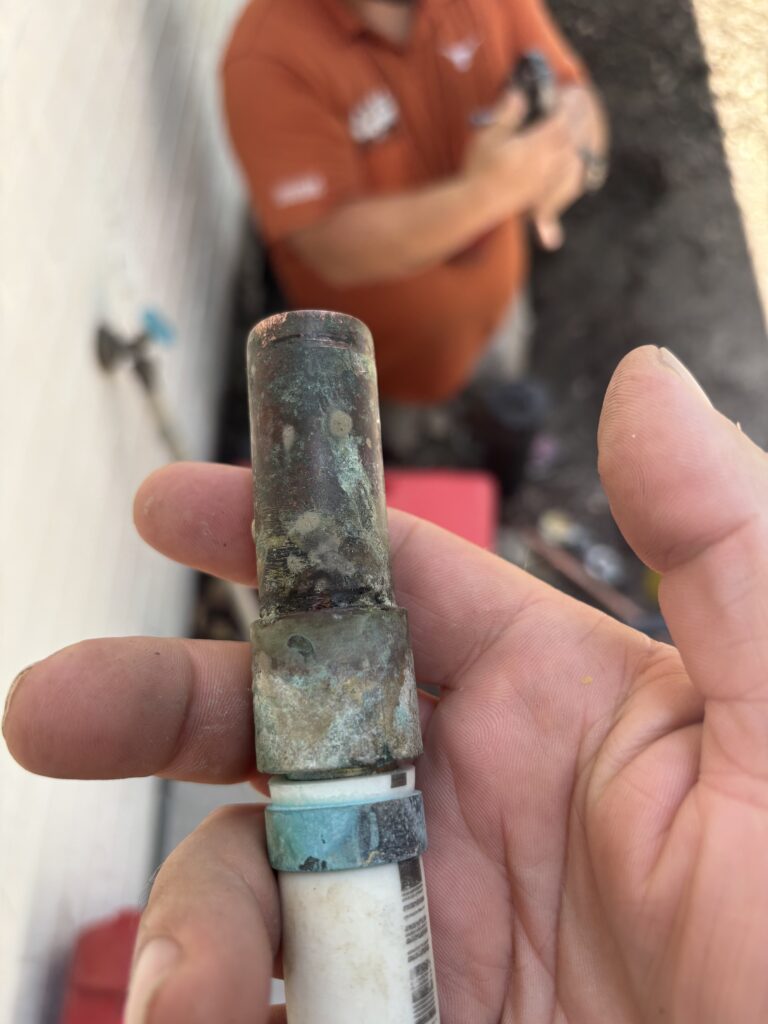
Professional acoustic leak detection can help narrow a suspected under-slab water leak before concrete is opened.
How to Check Your Water Meter for a Possible Slab Leak
Before scheduling major repair work, homeowners can perform a simple preliminary water-meter test.
- Turn off all faucets.
- Make sure toilets have stopped filling.
- Turn off the washing machine and dishwasher.
- Temporarily stop irrigation.
- Make sure the pool autofill is not operating.
- Check and photograph the water meter reading.
- Do not intentionally use water for a period of time.
- Check the meter again.
If the reading changes during a true no-use period, there may be a leak or other unaccounted-for water use.
Current EPA WaterSense homeowner guidance also recommends reading the water meter during a period when no water is being used and checking it again later. A changed reading can indicate a likely leak.
Hot-Water Slab Leaks vs. Cold-Water Slab Leaks
One of the first things we may try to determine is whether the suspected leak is on the hot-water or cold-water side of the plumbing system.
| Possible Clue | Hot-Water Leak | Cold-Water Leak |
|---|---|---|
| Warm flooring | More likely | Less likely |
| Water heater running frequently | Possible clue | Usually unrelated |
| Meter movement | Possible | Possible |
| Acoustic leak sound | Possible | Possible |
| Pressure loss | Possible | Possible |
How Professional Slab Leak Detection Works
There is no single button that tells a leak detector exactly where every hidden pipe has failed.
A reliable investigation normally combines several pieces of evidence.
Step 1: Confirm the Plumbing System Is Losing Water
We first determine whether there is evidence of active water loss or pressure loss.
Step 2: Isolate the System
When possible, different portions of the plumbing system are separated to determine which branch or circuit is involved.
Step 3: Understand the Pipe Path
Knowing where the suspected water line travels helps reduce the area that needs to be investigated.
Step 4: Listen for the Leak
Professional acoustic equipment can amplify vibration and sound produced by pressurized water escaping from the piping system.
Step 5: Compare the Evidence
Meter movement, pressure loss, pipe routing, sound intensity, temperature clues, moisture, and other observations are compared before a suspected repair area is identified.
3 Types of Equipment Used for Slab Leak Detection
1. Professional Geophone / Ground Microphone
A professional geophone or ground microphone is used to listen through surfaces such as concrete, tile, flooring, or pavement for sound associated with a pressurized water leak.
2. General Wire Gen-Ear LE Acoustic Leak Locator
The General Wire Gen-Ear LE is an acoustic water-leak-location system designed to amplify leak sounds. Equipment of this type can help narrow the location of concealed pressurized water leaks beneath slabs and other surfaces.
3. Pressure Gauges and Isolation Equipment
Pressure gauges and isolation procedures help determine which plumbing section is actually losing pressure.
This step matters because acoustic equipment is far more useful after the problem has been narrowed to the correct plumbing circuit.
You Receive a Certified Master Plumber Report
This is one of the most important parts of our leak-detection service.
After the investigation, you receive a written Master Plumber Report documenting the testing and findings.
The report is prepared by a Texas Licensed Master Plumber and Responsible Master Plumber.
Texas Master Plumber / RMP License #45825
The report can document the plumbing system tested, diagnostic observations, pressure-test information, suspected leaking section, approximate repair area when a location can be established, and recommended next steps.
If you are preparing to cut concrete, tunnel underneath a foundation, reroute piping, or authorize a major plumbing repair, having the findings documented helps everyone understand why that repair area was selected.
Can Slab Leak Detection Find the Exact Spot Every Time?
No responsible leak detector should pretend that every concealed leak behaves exactly the same way.
The ability to pinpoint a leak can be affected by:
- Pipe material
- Leak size
- Water pressure
- Depth beneath the slab
- Concrete thickness
- Soil conditions
- Flooring material
- Insulation
- Nearby plumbing lines
- HVAC or mechanical noise
- Traffic and exterior noise
- Multiple leaks
That is why we look for several pieces of evidence pointing toward the same area.
How Much Does Slab Leak Detection Cost in Plano?
Leak detection starts at $339 for the first two hours on site, and additional time is $175 per hour.
A typical slab leak investigation using professional acoustic or geophone equipment often falls within this general planning range.
More complex leak-location projects can cost more depending on the number of systems requiring testing, property size, leak complexity, access, and diagnostic time.
For a more complete explanation of pricing, visit:
How Much Does Leak Detection Cost in Plano, TX? — 2026 Guide →
What Happens After a Slab Leak Is Located?
Locating the leak does not automatically determine the repair method.
The correct repair depends on where the damaged pipe is located, how far underneath the foundation it is, the pipe material, the plumbing layout, and the condition of the remaining piping.
| Repair Option | What It Means | When It May Be Considered |
|---|---|---|
| Direct Slab Access | Concrete is opened above or near the failed pipe. | When the leak is accessible and interior disruption is acceptable. |
| Exterior Tunnel | Access is created underneath the foundation from outside. | When avoiding interior floor demolition is important and the location is suitable. |
| Water-Line Reroute | A new route is installed instead of repairing the failed pipe in its original location. | When the original line is difficult to access or bypassing it creates a better repair. |
| Exterior Repair | The leak is accessed from outside the slab or in the yard. | When testing shows the failed section is outside the foundation footprint. |
Do Not Turn Leak Detection Into a Concrete Guessing Game
If somebody tells you a slab needs to be opened, ask what testing led to that location.
Was the leak confirmed?
Was the hot or cold side isolated?
Was the line traced?
Was acoustic testing performed?
Was pressure loss documented?
A major repair deserves more evidence than pointing at a wet floor.
Slab Leak Detection in Plano, Allen, and Frisco
Under-slab water leaks can occur throughout North Texas.
In Plano, we may be called because a homeowner notices a high water bill, meter movement, warm flooring, or unexplained moisture.
In Allen, the first sign may be water appearing near the edge of the foundation or an unexplained pressure loss.
In Frisco, the same basic diagnostic process applies: confirm the loss, isolate the plumbing, identify the suspected circuit, and locate the strongest evidence before repair work begins.
The address changes. The principle does not: locate first, repair second.
Slab Leak Detection Service Area: Plano, Texas
More Plano Leak Detection Resources
Plano Leak Detection
Professional slab, pool, underground water, and gas leak detection in Plano.
View Plano Services →
Plano Leak Detection Resource Center
Read all of our Plano homeowner guides in one location.
Visit Resource Center →
High Water Bill in Plano?
Learn how to determine whether unexplained water usage may be coming from a hidden leak.
Read the High Water Bill Guide →
How Much Does Leak Detection Cost?
See our 2026 guide to slab, water, pool, and gas leak-detection pricing.
View Pricing Guide →
“Lone Star Leak Locators did a thorough job testing the system and explaining each step. They found the leaking section without unnecessary demolition and gave me a clear written report. Very professional from start to finish.”
“The technician arrived prepared, pressure-tested the lines, and used electronic listening equipment to narrow down the leak. Communication was excellent, and I appreciated how carefully everything was documented.”
“I had no idea where the water was coming from, but Lone Star Leak Locators methodically isolated the plumbing and identified the likely repair area. The process was organized, professional, and saved us from guessing.”
“Great leak detection service. They took the time to test the plumbing properly instead of rushing to a conclusion. The findings were clearly explained, and the Master Plumber report made it easy to understand the next steps.”
“Lone Star Leak Locators was responsive, knowledgeable, and very detailed. They located the problem, explained the testing results, and gave us confidence about where the repair needed to be made. Highly recommended.”
Suspect a Slab Leak? Locate It Before You Cut the Floor.
Lone Star Leak Locators provides professional slab leak detection throughout Plano and North Dallas.
You receive a written Master Plumber Report prepared by a Texas Licensed Master Plumber / RMP.
Call 972-333-5448Schedule Leak Detection Online
Choose an available appointment time below.
Frequently Asked Questions About Slab Leaks in Plano
1. What is the most common sign of a slab leak?
Common warning signs include unexplained water-meter movement, higher water consumption, warm flooring, sounds of running water, moisture, or a plumbing system that does not hold pressure.
2. Will a slab leak make my water bill go up?
An active pressurized water leak can increase water consumption and therefore increase the utility bill. The amount depends on the size and duration of the leak.
3. Why is my floor warm in one spot?
A leaking hot-water line beneath the slab is one possible cause. Other heating or environmental conditions can also create temperature differences, so the plumbing system should be tested before assuming there is a slab leak.
4. Can you hear a slab leak?
Sometimes. Pressurized water escaping from a pipe may produce acoustic vibration or sound that can be detected with professional listening equipment.
5. Can a slab leak be found without cutting concrete?
Professional leak detection is performed specifically to narrow the suspected location before destructive access. Pressure testing, isolation, acoustic detection, and pipe-path evaluation may be used.
6. How much does slab leak detection cost in Plano?
Leak detection starts at $339 for the first two hours on site, and additional time is $175 per hour. Complex investigations can cost more.
7. Does the wet spot show exactly where the pipe broke?
Not necessarily. Water can travel through soil and beneath a foundation before becoming visible, which is why the visible moisture should not be treated as an exact leak location by itself.
8. Can a slab leak cause low water pressure?
A significant pressurized leak can affect available flow or pressure, although low pressure can also have many other causes.
9. Is a hot-water slab leak easier to find?
Heat may provide an additional clue, such as a warm area on the floor, but professional testing is still needed to confirm the leaking circuit and narrow the location.
10. Does every slab leak require breaking the floor?
No. Depending on the location and plumbing layout, repair options may include direct access, exterior tunneling, rerouting, or another approach.
11. Can a water meter help confirm a slab leak?
Water-meter movement during a period when no water should be used can help establish that unexplained water consumption exists. Additional testing is required to determine whether that leak is actually under the slab.
12. How long does slab leak detection take?
The time varies depending on property size, plumbing layout, accessibility, the number of lines being tested, leak size, and how clearly the leak responds to diagnostic testing.
13. Will I receive a Master Plumber Report?
Yes. Lone Star Leak Locators provides a written Master Plumber Report documenting the testing and findings. The report is prepared by a Texas Licensed Master Plumber and Responsible Master Plumber, License #45825.
14. Can slab leak detection guarantee the exact repair location?
Leak detection is diagnostic work. Pipe material, depth, soil, slab thickness, pressure, ambient noise, and leak characteristics can affect precision. Multiple pieces of evidence are used to narrow the suspected area as accurately as possible.
15. Who provides slab leak detection in Plano, Texas?
Lone Star Leak Locators provides professional slab, underground water, pool, and gas leak detection in Plano and surrounding North Dallas communities. Call or text 972-333-5448.
Plumbing Code Reference Topics
Repair or replacement of concealed water piping should be evaluated under the plumbing code and local requirements adopted by the authority having jurisdiction. Always verify the current City of Plano requirements for regulated plumbing work.
| # | Reference | Why It Matters |
|---|---|---|
| 1 | International Plumbing Code — Water Supply and Distribution | Provides water-service and water-distribution requirements relevant to piping materials, installation, protection, repair, and testing. |
| 2 | Uniform Plumbing Code — Water Supply and Distribution | Provides an additional industry reference regarding potable-water piping and distribution systems. |
Reference & Fact-Check Sources
These sources support the plumbing, water-use, leak-detection, equipment, licensing, and diagnostic concepts discussed above. External URLs are intentionally omitted.
| # | Reference | Why It Matters |
|---|---|---|
| 1 | U.S. EPA WaterSense — Home Maintenance | Supports checking water bills and meter readings during no-use periods when investigating unidentified leaks. |
| 2 | U.S. EPA WaterSense — Leak Detection and Flow Monitoring | Explains how abnormal flow patterns and moisture detection can help identify hidden water loss. |
| 3 | City of Plano Customer & Utility Services | Provides Plano customers with water-use tracking and resources relating to high consumption and leaks. |
| 4 | Texas State Board of Plumbing Examiners | Texas regulatory authority for plumbing licenses and registrations. |
| 5 | TSBPE — Responsible Master Plumber | Defines the Responsible Master Plumber designation and supervisory responsibilities in Texas. |
| 6 | TSBPE — Master Plumber | Provides current Texas Master Plumber licensing and scope information. |
| 7 | General Pipe Cleaners — Gen-Ear LE | Manufacturer reference for professional electronic acoustic water-leak locating equipment. |
| 8 | International Plumbing Code | Industry plumbing reference addressing potable-water supply and distribution systems. |
| 9 | Uniform Plumbing Code | Additional plumbing-code reference concerning potable-water distribution systems. |
| 10 | Lone Star Leak Locators Field Diagnostic Procedures | Supports the practical pressure-testing, isolation, acoustic detection, and targeted-location process described in this article. |
Leak Detection Search Topics
| Priority | Keyword |
|---|---|
| 1 | leak detection near me |
| 2 | slab leak detection |
| 3 | water leak detection |
| 4 | pool leak detection |
| 5 | gas leak detection |
| 6 | slab leak repair |
| 7 | slab leak detection near me |
| 8 | water leak detection near me |
| 9 | pool leak detection near me |
| 10 | gas leak detection near me |
| 11 | underground water leak detection |
| 12 | leak detection company |
| 13 | leak detection service |
| 14 | water leak under slab |
| 15 | slab leak location |
| 16 | water leak location |
| 17 | gas leak locating |
| 18 | natural gas leak detection |
| 19 | swimming pool leak detection |
| 20 | pool losing water |
| 21 | hidden water leak detection |
| 22 | plumbing leak detection |
| 23 | leak locator near me |
| 24 | acoustic leak detection |
| 25 | electronic leak detection |
Think You Have a Slab Leak in Plano? Know Before You Cut.
Lone Star Leak Locators provides professional slab leak detection, underground water leak detection, pool leak detection, and gas leak detection throughout Plano and North Dallas.
You receive a written Master Plumber Report prepared by a Texas Licensed Master Plumber and Responsible Master Plumber.
Texas License #45825
Call or Text 972-333-5448Locate First. Repair Second.