

A failed gas pressure test means the isolated piping did not maintain the required test condition during the observed period. It does not automatically identify the leaking fitting, appliance valve, connector, or buried pipe.
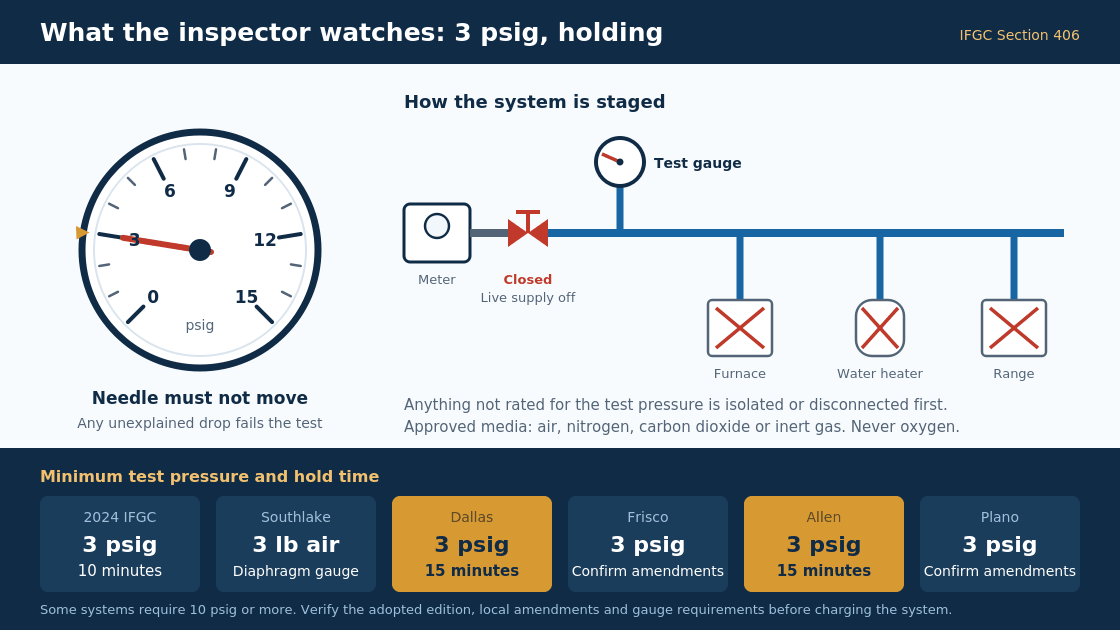
What a failed gas pressure test actually proves
First, a pressure test asks one narrow question: can the isolated piping hold the test medium and pressure under the test conditions? If the gauge falls after the tester accounts for temperature and setup effects, the system has not passed that test. However, the result does not reveal which joint is leaking. It also does not establish that every appliance is defective.
Next, the tester confirms that the gauge, hose, test connection, capped outlets, and isolation points are sound. A loose temporary cap can mimic a building-piping failure. After the tester verifies the setup, the search moves through the system in sections.
Why the exact procedure can differ
Local authorities and utilities control restoration requirements. Therefore, test pressure, duration, permitted medium, inspection paperwork, and who may perform the work can differ by city and by the reason the utility stopped service. A model fuel-gas code is not automatically the rule in every DFW city. Instead, the adopted local edition and amendments govern.
A leak-location visit does not promise that the city or utility will restore gas. Rather, it provides documented findings for the licensed professional completing repairs and the inspection process.
Common places a gas system can lose pressure
- Threaded joints at valves and appliance branches
- Uncapped or poorly capped abandoned outlets
- Damaged appliance connectors that are part of the evaluated scope
- Corroded exterior or underground metallic piping
- Valve stems or shutoff components
- Temporary test fittings or gauge connections
The correct next step depends on how the system is arranged. Opening random walls is not a diagnostic plan.
How sectional isolation narrows the search
The tester divides the piping at accessible branches or valves. Then, the tester evaluates each section. If one section holds and another falls, the search area gets smaller. At that point, the tester may use electronic gas detection, approved leak-detection solution, tracer methods, or targeted access where appropriate.
Never use an open flame to search for a gas leak. The Railroad Commission of Texas gas-leak safety notice also directs people to leave immediately and avoid operating electrical devices when gas is smelled.
A practical sequence after a failed gas pressure test
- Keep the affected system out of service.
- Confirm the test assembly and temporary caps are tight.
- Document starting pressure, ending pressure, elapsed time, and conditions.
- Isolate accessible branches to reduce the search area.
- Use appropriate detection methods on the failing section.
- Document the location and limitations for the repair professional.
- Retest after repair and follow the local inspection and utility-restoration steps.
What a useful leak-location visit should document
A sound investigation separates observations from conclusions. The written findings should identify what was tested, what held, what did not, which access points were used, and what limited the work. Equipment such as pressure gauges, thermal imaging, acoustic listening devices, tracer tools, or electronic line locators should support a conclusion rather than replace one.
Lone Star Leak Locators serves homeowners in Plano, Allen, Frisco, Richardson, McKinney, and nearby North Dallas communities. The goal is to narrow the problem before repair access begins. Call or text 972-333-5448 if you need help deciding which test fits the evidence at your property.
Related resources
- Gas leak detection and Master Plumber documentation
- Why a soap-bubble check may not answer the whole question
- Explore Lone Star Leak Locators services
Frequently asked questions
Does a pressure drop always mean the buried line leaks?
No. The loss may be in exposed piping, a valve, an outlet cap, a connector within the test scope, or the test setup itself.
Can I turn the gas back on after the gauge stops moving?
Do not restore service yourself. Follow the licensed repair, inspection, and utility process that applies to the property.
Is a failed test the same as locating the leak?
No. It confirms a test failure. Sectional isolation and targeted detection are used to locate the likely source.
Can temperature change affect the gauge?
Temperature can affect pressure readings. The tester should account for conditions and verify the setup before drawing a conclusion.
Will every city require the same test?
No. Local adoption, amendments, inspection procedures, and utility requirements can differ across DFW.
Can appliances stay connected during testing?
That depends on the approved procedure and scope. Appliances and regulators must be protected from inappropriate test pressure.
What paperwork should I keep?
Keep the test record, findings, repair invoice, permit or inspection documents, and utility-restoration confirmation.
What if I smell gas after a repair?
Leave immediately and call 911 and the gas utility from a safe location. Do not wait for a routine appointment.
Schedule professional leak detection
Call or text 972-333-5448, or use the secure scheduling page below.