
Gas Leak Detection in Dallas & Plano, TX: How We Find Natural Gas Leaks
Written by Steven Shipler, Texas Licensed Master Plumber, Responsible Master Plumber (RMP), MBA. Texas Master Plumber License #45825.
If you smell natural gas, have failed a gas pressure test, have had your gas meter removed, or suspect a leaking gas line somewhere between the meter and an appliance, finding the actual source of the leak is the first step toward making the system safe again.
Lone Star Leak Locators provides professional gas leak detection in Dallas and Plano, Texas using systematic pressure testing, electronic gas detection, system isolation, and professional diagnostic procedures designed to narrow down where a gas piping system is losing pressure.
We do not believe in randomly opening walls, cutting floors, replacing entire gas systems, or excavating a yard before the problem has been properly investigated.
Smell Gas Right Now? Leave the Area First.
If you smell a strong rotten-egg or sulfur-like odor, hear gas escaping, or believe there may be an active natural-gas leak, do not stay inside trying to find it yourself.
Leave the affected area immediately. From a safe location, call 911 and your natural-gas utility emergency service. Atmos Energy’s published emergency number is 866-322-8667.
You Receive a Certified Master Plumber Report
One of the biggest differences with Lone Star Leak Locators is that our diagnostic service does not end with someone simply telling you, “We think the leak is over there.”
You will receive a Certified Master Plumber Report prepared by a Texas Licensed Master Plumber.
The report documents the testing performed, significant observations, findings, and recommended next steps so you have something meaningful to provide to a homeowner, property manager, contractor, insurance company, buyer, seller, or repair plumber.
Texas Licensed Master Plumber #45825
Responsible Master Plumber (RMP)
Need Gas Leak Detection in Dallas or Plano?
Professional gas pressure testing, leak locating, system isolation, and Master Plumber reporting.
Call 972-333-5448What Does Gas Leak Detection Actually Mean?
Gas leak detection is the process of determining whether a fuel-gas piping system is leaking and then narrowing the problem to a specific branch, fitting, valve, appliance connection, underground service line, or section of piping.
There is an important difference between proving that a system leaks and finding exactly where the leak is located.
A pressure test may confirm that the system is losing pressure.
The next step is locating the source.
That can require isolating different sections of the gas piping, checking valves and appliance connections, using electronic combustible-gas detection equipment, evaluating accessible joints, and performing additional pressure testing.
Common Signs of a Natural Gas Leak
- Rotten-egg or sulfur-like odor
- Hissing or whistling near gas piping
- Gas service unexpectedly shut off
- Failed gas pressure test
- Utility company identifies a possible leak
- Gas meter will not be released or reconnected
- Gas odor near a furnace, water heater, fireplace, or range
- Gas odor near the meter or yard service
- Recent foundation movement
- Recent remodeling or gas piping modifications
- Old threaded black steel gas piping
- Corrosion on exterior or underground piping
- Recent excavation near a gas line
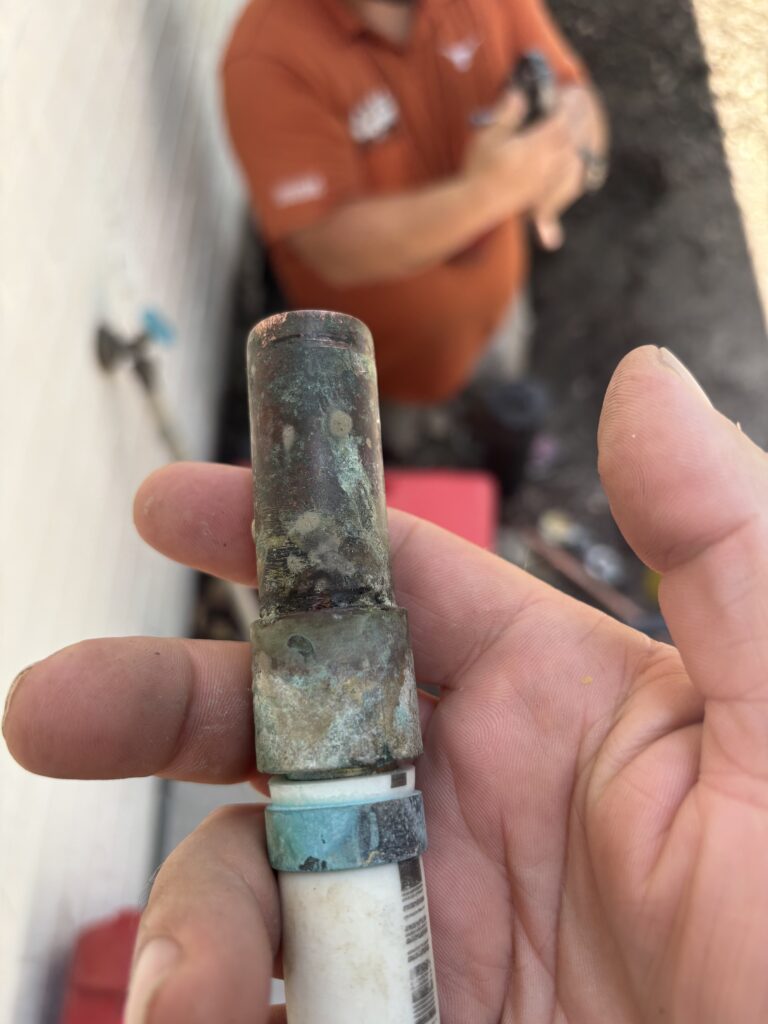
How We Find a Gas Leak
The exact procedure depends on the property and why the gas system is being tested, but a professional investigation normally works from the broad problem toward the specific problem.
Step 1: Understand Why the Gas System Failed
We first determine what happened. Did the homeowner smell gas? Did the utility shut the meter off? Did another contractor perform a test? Was the line recently modified? Has foundation work occurred? Is the suspected leak indoors, underground, or near an appliance?
Step 2: Pressure-Test the Gas Piping
A pressure test helps establish whether the piping system can maintain the required test pressure. If pressure drops, we know the system requires additional investigation before it can be considered tight.
Step 3: Isolate Sections of the System
Where practical, individual branches or portions of the piping system can be isolated. This is one of the most useful diagnostic techniques because it converts one large piping system into smaller sections that can be evaluated independently.
Step 4: Use Electronic Gas Detection
An electronic combustible-gas detector can help identify the presence of combustible gas around accessible piping, valves, fittings, meter connections, appliance shutoffs, and equipment.
Step 5: Narrow Down the Repair Area
The objective is to give the customer and repair plumber the smallest reasonable diagnostic area instead of simply recommending replacement of everything.
Step 6: Prepare the Master Plumber Report
The findings are documented in a written report prepared by a Texas Licensed Master Plumber so the customer understands what was tested, what was found, and what should happen next.
Three Important Tools Used During Gas Leak Diagnostics
1. Electronic Combustible-Gas Detector
Electronic gas detection equipment can help identify combustible-gas concentrations around accessible fittings, valves, appliance connections, regulators, and piping.
2. Gas Pressure Test Gauge or Manometer
Pressure-testing equipment is used to determine whether the piping system can maintain pressure. This is especially important after a gas leak repair or when a municipality requires a witnessed gas test before service can be restored.
3. Approved Leak-Detection Solution
Accessible joints and fittings may be checked with an appropriate noncorrosive leak-detection solution when conditions permit. Formation of bubbles can help identify leakage at a particular accessible connection.
Important: acoustic water-leak equipment such as a geophone or General Wire Gen-Ear LE is designed for locating pressurized water leaks. It should not be confused with equipment used for natural-gas detection.
Gas Leak Detection in Dallas, Texas
Dallas has specific requirements surrounding gas-system testing and restoration of gas service.
The City of Dallas currently publishes gas-test guidelines referencing the 2021 International Fuel Gas Code and Dallas amendments.
For a Dallas gas test requiring city inspection, the city’s published guideline calls for the fuel-gas piping system to be tested using an approved diaphragm test gauge at 3 psig for a minimum of 15 minutes while witnessed by a Dallas plumbing inspector.
The city may also require a plumbing permit and gas inspection when fuel-gas piping has been repaired, replaced, changed, or when gas service must be formally released for reconnection.
That means gas leak locating in Dallas often involves more than simply finding a leaking threaded fitting. The complete process can involve:
- Leak diagnosis
- Pressure testing
- Repair planning
- Plumbing permit
- City inspection
- Gas test
- Gas release
- Utility reconnection
Dallas Service Area Map
Gas Leak Detection in Plano, Texas
Plano homeowners also frequently need gas-system testing after a suspected leak, appliance change, gas piping repair, remodeling project, utility interruption, or failed pressure test.
Plano Building Inspections handles building, plumbing, and related inspection requirements. The City of Plano currently identifies its 2024 construction codes as effective August 1. Because permit and inspection requirements can vary depending on exactly what part of the gas system is being repaired, the applicable requirements should be confirmed for the individual project.
Lone Star Leak Locators can perform the diagnostic work needed to determine whether a gas system is leaking and help identify the likely location before the repair scope is finalized.
Plano Service Area Map
Gas Leak Detection in Richardson and North Dallas
We also perform leak-detection work throughout nearby North Dallas communities, including Richardson and surrounding areas.
The same principle applies regardless of city: determine whether the gas piping system is actually leaking, isolate the problem as much as practical, identify the repair area, and then follow the applicable municipal permit and inspection requirements before the system is returned to service.
Finding Underground Gas Leaks
Underground gas piping presents a different challenge because the line cannot be visually inspected without excavation.
Depending on the system configuration, the diagnostic process may involve isolating the underground portion from interior piping and determining whether that section holds pressure.
If an underground section is proven to leak, the next question becomes whether the line should be spot repaired or replaced.
Excavating blindly without first establishing which portion of the system is leaking can create unnecessary labor and property damage.
Finding Gas Leaks Under or Around a Foundation
Gas lines can pass through difficult areas around foundations, crawl spaces, walls, attics, fireplaces, kitchens, mechanical rooms, and exterior walls.
Foundation movement can also place stress on piping and fittings.
When the leak cannot be seen directly, pressure testing and system isolation become extremely important.
A Field Observation From a Master Plumber
One pattern I see repeatedly is that customers assume a failed gas test means the entire gas system has to be replaced. That is not necessarily true. A system can contain many branches, valves, fittings, and appliance connections. The diagnostic work matters because narrowing the failure to a particular portion of the system can completely change the repair plan.
Why System Isolation Matters
Imagine a home with gas serving:
- Two water heaters
- A gas furnace
- A cooktop
- A fireplace
- A clothes dryer
- An outdoor grill
If the entire system fails a pressure test, simply knowing that pressure dropped does not tell you which branch caused the failure.
By narrowing the system into smaller sections, a technician can often determine whether the problem is associated with an appliance branch, exterior line, yard service, or another part of the system.
Gas Leak Detection vs. Gas Leak Repair
These are two different services.
Gas leak detection determines whether a leak exists and works to identify where it is located.
Gas leak repair corrects the actual defect.
Sometimes the same plumbing contractor performs both.
In other situations, the customer wants an independent diagnostic report first so repair contractors can bid from a better-defined scope.
That is one reason the Master Plumber Report is valuable.
Why the Master Plumber Report Matters
A gas-system diagnosis can affect a major repair decision.
You may be deciding whether to:
- Repair one threaded fitting
- Replace an appliance shutoff valve
- Replace a branch line
- Replace an underground yard service
- Repipe a portion of the house
- Replace the entire gas piping system
Those are very different scopes of work.
Our goal is to document the evidence before the customer commits to unnecessary work.
Stop Guessing Where the Gas Leak Is
Have the system professionally tested and receive written findings from a Texas Licensed Master Plumber.
Master Plumber License #45825
972-333-5448Schedule Your Leak Detection Online
Choose an available appointment time below.
Frequently Asked Questions About Gas Leak Detection
1. What should I do if I smell natural gas?
Leave the affected area immediately. Do not remain inside attempting to locate the leak. From a safe location, contact 911 and your natural-gas utility emergency service.
2. How does a plumber find a gas leak?
The process may include pressure testing, isolating piping sections, electronic combustible-gas detection, checking accessible valves and fittings, and evaluating individual gas branches.
3. Can you locate a gas leak without opening walls?
Sometimes. Diagnostic testing can often narrow the suspected area before demolition is considered. The ability to pinpoint the leak depends on the location, piping configuration, accessibility, and type of failure.
4. What does a failed gas pressure test mean?
A pressure loss indicates that the tested system is not maintaining pressure as expected. Further isolation and diagnostic work may be necessary to identify the leaking section.
5. What gas pressure test does Dallas require?
Dallas currently publishes a guideline calling for an approved diaphragm test gauge with a test pressure of 3 psig maintained for at least 15 minutes and witnessed by a City of Dallas plumbing inspector when the applicable city gas test is required.
6. Does Plano require a permit after a gas-line repair?
Permit and inspection requirements depend on the type and scope of work. Plano Building Inspections should be consulted for the current requirements applicable to the specific project.
7. Will I receive a written gas leak report?
Yes. Lone Star Leak Locators provides a Certified Master Plumber Report documenting significant testing, findings, and recommended next steps. The report is prepared by a Texas Licensed Master Plumber.
8. Can you find an underground gas leak?
Underground gas piping can often be evaluated by isolating and pressure-testing the underground section. The repair strategy depends on the location and configuration of the failed piping.
9. Can foundation movement cause gas piping problems?
Movement of a structure or surrounding soil can place stress on piping and fittings. If gas odor or a failed pressure test occurs following foundation movement or repairs, the gas system should be evaluated.
10. How long does gas leak detection take?
The time varies considerably. A simple accessible fitting may be identified quickly, while a larger house with multiple branches, underground piping, or an intermittent failure may require significantly more diagnostic work.
11. How much does gas leak detection cost?
Cost depends on the size of the system, accessibility, number of gas branches, whether the leak is underground, whether city testing is required, and how much isolation work is necessary. Call 972-333-5448 for pricing based on your property and situation.
12. Is leak detection the same as repairing the gas line?
No. Leak detection identifies and narrows the problem. Repair corrects the damaged piping, fitting, valve, or connection. The diagnostic findings help define the repair scope.
13. Will the gas system need another pressure test after repair?
Gas piping repairs commonly require testing before the system is returned to service, and municipal inspection requirements may apply depending on the work performed.
14. Why hire a Texas Responsible Master Plumber?
A Texas Responsible Master Plumber carries responsibility for the general supervision and management of plumbing work performed under the plumbing license, including applicable permits and inspections.
15. Do you provide gas leak detection near me?
Lone Star Leak Locators provides gas leak detection throughout Dallas, Plano, Richardson, North Dallas, and surrounding Dallas-Fort Worth communities. Call 972-333-5448 to confirm service availability.
Gas Leak Detection Reference & Code Topics
These are the primary code, licensing, municipal, and safety topics relevant to professional natural-gas leak detection and testing. External URLs have intentionally not been included.
| # | Reference | Why It Matters |
|---|---|---|
| 1 | International Fuel Gas Code | Primary model-code reference for fuel-gas piping, installation, testing, and related safety requirements. |
| 2 | IFGC Fuel-Gas Piping Requirements | Addresses fuel-gas piping materials, installation, testing, protection, and system requirements. |
| 3 | Uniform Plumbing Code Fuel-Gas Provisions | Fuel-gas provisions may apply in jurisdictions adopting the UPC; always verify local adoption. |
| 4 | NFPA 54 — National Fuel Gas Code | Widely recognized fuel-gas installation and safety standard referenced within the industry. |
| 5 | City of Dallas Fuel Gas Code Amendments | Dallas-specific amendments apply to fuel-gas work within city jurisdiction. |
| 6 | City of Dallas Gas Test Guidelines | Publishes Dallas requirements for gas-test inspections and gas-service release procedures. |
| 7 | City of Plano Building Codes & Ordinances | Provides current Plano adopted-code and building-inspection information. |
| 8 | Texas State Board of Plumbing Examiners | Regulates plumbing licenses and registrations in Texas. |
| 9 | Texas Responsible Master Plumber Requirements | Defines RMP supervision, management, permit, inspection, and licensing responsibilities. |
| 10 | Natural Gas Utility Safety Procedures | Provides public safety guidance for recognizing and responding to suspected natural-gas releases. |
Dallas-Fort Worth Leak Detection Keywords
| Priority | Keyword |
|---|---|
| 1 | leak detection near me |
| 2 | slab leak detection |
| 3 | water leak detection |
| 4 | pool leak detection |
| 5 | gas leak detection |
| 6 | slab leak repair |
| 7 | slab leak detection near me |
| 8 | water leak detection near me |
| 9 | pool leak detection near me |
| 10 | gas leak detection near me |
| 11 | underground water leak detection |
| 12 | leak detection company |
| 13 | leak detection service |
| 14 | water leak under slab |
| 15 | slab leak location |
| 16 | water leak location |
| 17 | gas leak locating |
| 18 | natural gas leak detection |
| 19 | swimming pool leak detection |
| 20 | pool losing water |
| 21 | hidden water leak detection |
| 22 | plumbing leak detection |
| 23 | leak locator near me |
| 24 | acoustic leak detection |
| 25 | electronic leak detection |
Primary DFW Local SEO Targets
- Gas Leak Detection Dallas TX
- Gas Leak Detection Plano TX
- Gas Leak Detection Richardson TX
- Gas Leak Detection North Dallas TX
- Natural Gas Leak Detection Dallas
- Natural Gas Leak Detection Plano
- Gas Leak Locating Dallas TX
- Gas Leak Locating Plano TX
- Gas Leak Detection Near Me
- Licensed Master Plumber Gas Leak Detection
Gas Leak Detection in Dallas & Plano
Professional testing. Professional locating. Written findings.
Certified Master Plumber Report Included
Texas Licensed Master Plumber
Responsible Master Plumber
License #45825