
Case study · Richardson, TX · September 2026
A large pool in Richardson was losing about 4 inches of water a day. The owner could not find a wet spot anywhere. We found the leak in an underground return line under the pool deck, just outside the equipment fence, and it was repaired by tunneling under the deck without breaking any concrete. When we retested, the line held.
Location: Richardson, Texas
Problem: large pool losing about 4 inches of water a day
Dye test: negative at every fitting, light, skimmer, drain and crack
Pressure test: every line held except the pool return line, which lost about 1.2 psi of air every 3 minutes
Leak: return line under the concrete deck, just outside the equipment fence, marked with a blue X
Repair: tunneled about 3 feet under the deck and repaired the pipe with the concrete left intact
Result: no movement on the pressure gauge at the retest
Step 1: Dye testing came back clean
I swam the pool and dye tested everything a pool can leak through: the lights, the returns, the spa returns and spa jets, every skimmer basket, skimmer housing and drain, and every crack I could see. A couple of times it looked like the dye moved. Each time, a second look showed nothing.
A clean dye test does not mean there is no leak. It means the leak is somewhere dye cannot reach, which usually points to the underground plumbing.
Step 2: Pressure testing each line on its own
Next we plugged and pressure tested the lines one at a time, watching a gauge on each:
- Main drain lines: held
- Skimmer lines: held
- Spa jets: held
- Spa main drain: held
- Pool return line: did not hold, losing about 1.2 psi of air every 3 minutes
That narrowed a whole pool’s worth of plumbing down to one line.
Step 3: Listening along the return line
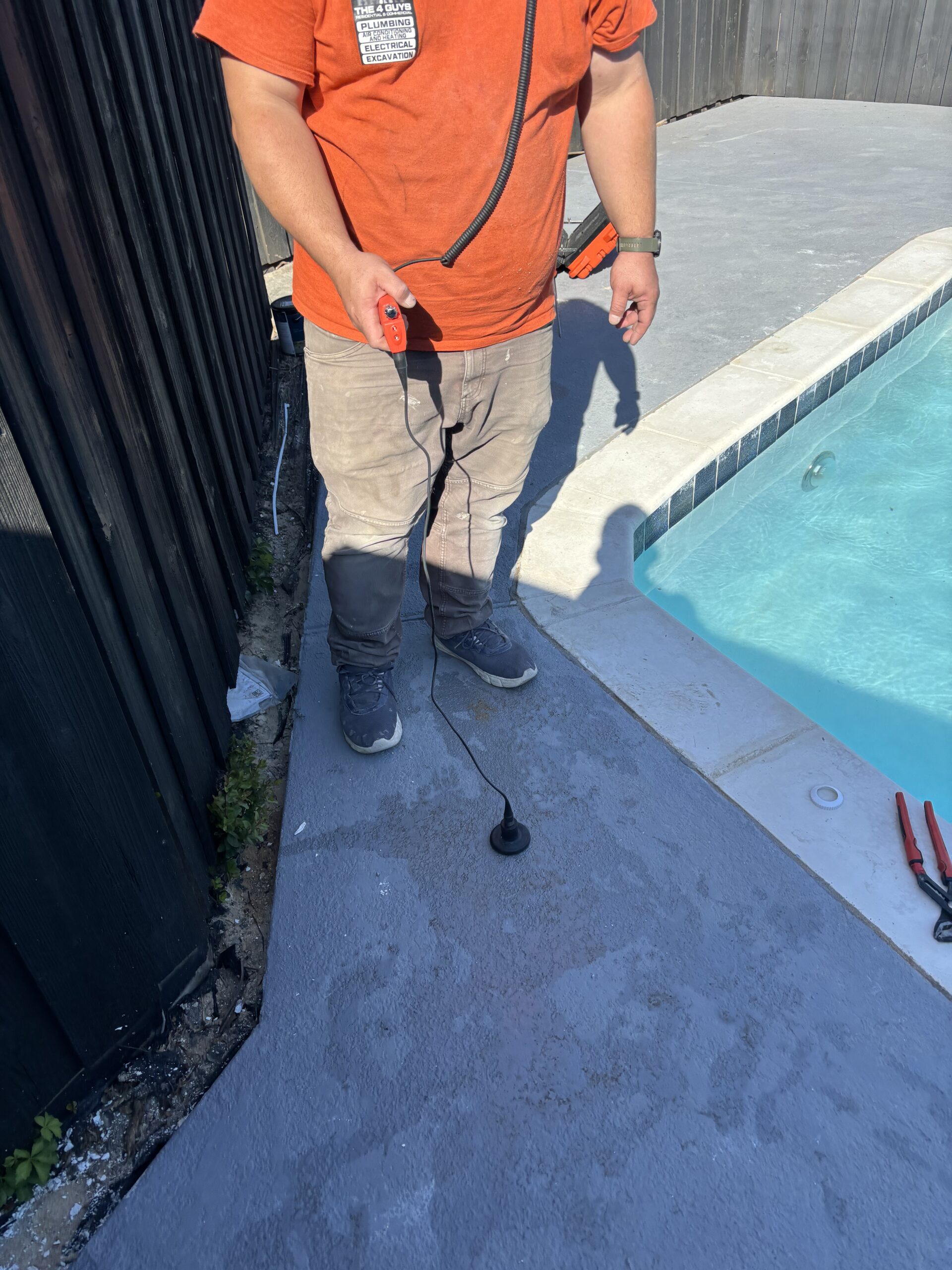
A loss of 1.2 psi in 3 minutes is a small leak, and small leaks are hard to hear. I worked from the equipment pad toward each return with a geophone and line tracing, listening every foot or two along the route.
The job site was not quiet. There was construction nearby, a dog barking, music playing, and our own feet shuffling on the deck. Every one of those can sound like a leak through the headphones, and they gave me a few false readings. I had everyone stand completely still more than once and rechecked each suspicious sound.
On the line running close to the equipment fence, I finally heard a clear gurgle in the same spot every time. We marked it with a blue X.
Step 4: Repairing it without breaking the deck
Because the leak was pinned to one spot, the repair could be planned around that single point instead of cutting the deck in a few likely places. The written repair plan was:
- Move the equipment fence temporarily for access, then put it back.
- Dig and tunnel under the existing concrete deck to reach the leaking pipe.
- Repair the pipe from underneath, leaving the concrete intact.
- Retest the line after the repair.
The plan also protected the homeowner: if the concrete had to be cut to reach the pipe, work would stop and the owner would be contacted first, with any concrete work priced and approved separately.
It never came to that. The crew tunneled about 3 feet under the deck, reached the pipe and made the repair. When the line was retested, there was no movement on the pressure gauge.
What it cost
The fixed repair estimate was $2,460 for the tunneling access and the pipe repair. It did not include any concrete cutting or replacement, because the goal was to avoid that work entirely.
Leak detection is priced separately. It starts at $339 for the first two hours, then $175 per additional hour, and every visit includes a written Certified Master Plumber Report.
What Richardson pool owners can take from this
- A clean dye test is not the end of the search. When dye shows nothing and the pool keeps dropping, the leak is usually in the underground lines.
- Test every line separately. Testing line by line is what turned “somewhere in the plumbing” into one return line.
- Locate before you cut. A confirmed spot is what made a repair with no concrete demolition possible.
- Get the plan in writing. A good estimate says what is included, what is not, and what happens if conditions change underground.
Pool losing water in Richardson or North Dallas?
Call or text 972-333-5448, or schedule online. Learn what goes into the Certified Master Plumber Leak Report, read what to do when a dye test finds nothing, or see our pool leak detection service.
Written by Steven Shipler, Texas Master Plumber, RMP #45825.