
Gas Leak Detection in Southlake, Dallas, Frisco, Allen & Plano, TX: Common Causes, Pressure Testing & How Atmos Energy Turns Your Gas Back On
Professional gas leak detection is usually the first step after Atmos Energy red-tags a home, shuts off the natural gas and locks the meter. Therefore, this guide walks through five representative leak scenarios from across the Metroplex, and then explains the repair, permitting, pressure-testing and gas-release steps that stand between a locked meter and hot water again.
Serving Southlake, Dallas, Frisco, Allen, Plano and the surrounding Dallas–Fort Worth communities.
Read First: If You Smell Natural Gas Right Now
A rotten-egg odor, a hissing sound near piping, or blowing dirt above a buried line all point to a possible active leak. Above all, get everyone out of the building and move well away from it before you do anything else.
On your way out, leave light switches, garage door openers, thermostats and phones alone. In addition, do not start a vehicle in an attached garage, and do not attempt your own gas leak detection inside the structure.
Once you are at a safe distance, call 911 and the Atmos Energy 24-hour emergency line: 866-322-8667 .
Finally, stay out until the fire department or the gas utility confirms that the building is safe to enter.
Why North Texas Homes Need Gas Leak Detection
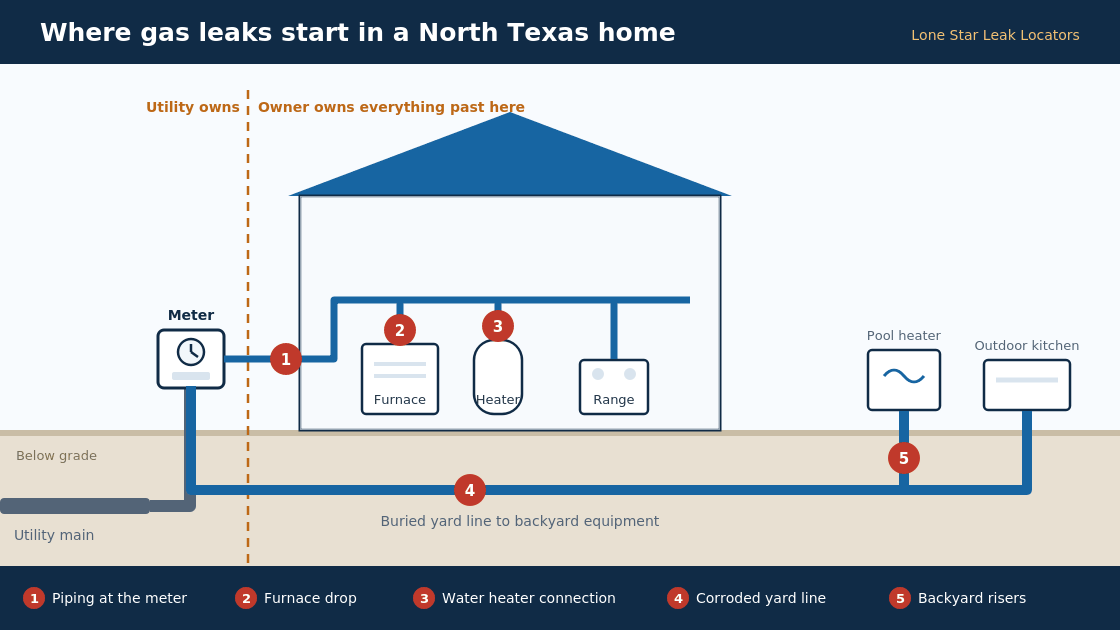
Natural gas heats homes, fires water heaters and feeds ranges, fireplaces, pool heaters and outdoor kitchens across Southlake, Dallas, Frisco, Allen and Plano. Consequently, all of that equipment depends on a piping system that has to stay sealed at every joint, every valve and every buried foot of pipe.
Generally, leaks show up in three broad places: in buried yard lines, inside the structure, and at the point where an appliance ties into the system. However, each one calls for a different gas leak detection approach, and each one carries a different repair scope.
When Atmos Energy finds gas escaping from customer-owned piping, the utility can shut the service down and secure the meter until the defect is corrected. In other words, that shutoff is a safety decision rather than a billing action.
If a utility lock is on your meter, leave it alone. Cutting it, prying it off or opening the valve behind it is both dangerous and a violation of the utility’s terms of service.
Typically, getting service back means a licensed professional completes gas leak detection and repair, the city permits and inspects the work, the city issues a gas release, and finally Atmos Energy dispatches a technician to reconnect.
The Restoration Sequence in Nine Moves
- First, Atmos Energy investigates, confirms an unsafe condition and secures the meter.
- Next, a licensed professional working under a Responsible Master Plumber performs gas leak detection to isolate and locate the defect.
- Then the contractor pulls the applicable city gas or plumbing permit.
- After that, the defective piping, fitting or connection is repaired or replaced with approved materials.
- Meanwhile, the system is isolated, charged and held for the required pressure test.
- Subsequently, a city plumbing or building inspector witnesses that test and reviews the repair.
- Once approved, the city records the passed inspection and issues or transmits the gas release.
- Atmos Energy then verifies the release and schedules reconnection.
- Finally, an authorized Atmos technician removes the lock, restores service and performs utility safety checks.
Of course, permit categories, test pressures, test durations and release procedures vary by city, property type and the reason the service was disconnected.
Six Conditions Behind Most Residential Gas Leaks
Pipe age, installation quality, soil chemistry, corrosion protection, ground movement and appliance hookups all influence how long a gas system stays tight. Generally, these six patterns account for the majority of what gas leak detection technicians find in the field.
1. Corroded Underground Yard Lines
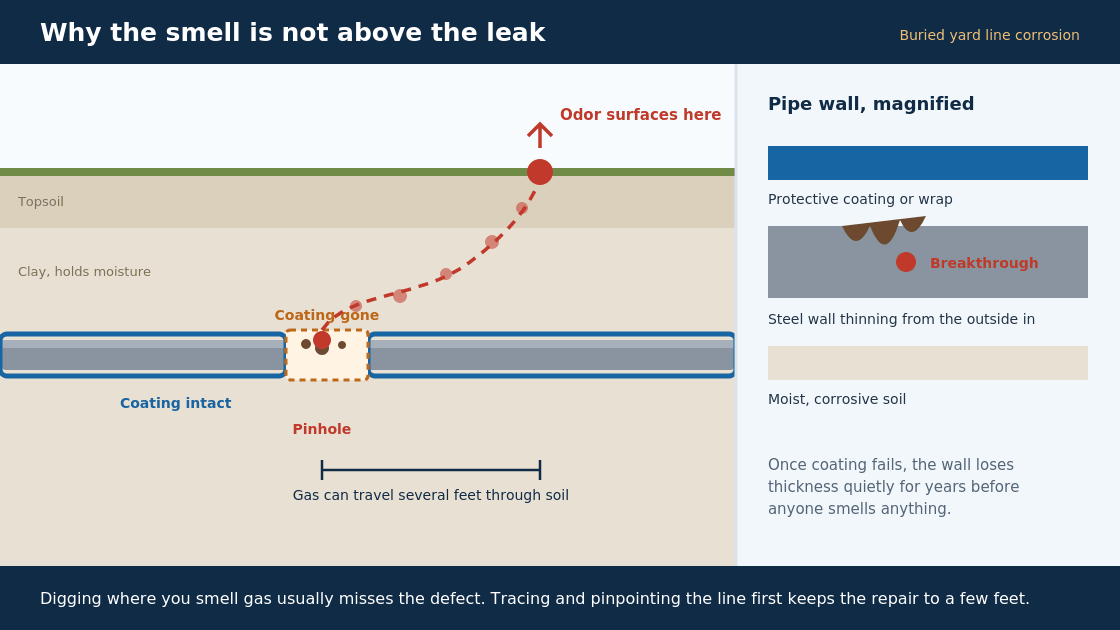
Buried metallic pipe sits in soil that holds moisture and, in parts of North Texas, chemistry that attacks steel. Because the coating, wrap or cathodic protection eventually fails, the pipe wall thins from the outside in.
Eventually a pinhole opens and gas migrates through the soil. In fact, it often surfaces several feet from the actual defect, which is precisely why underground gas leak detection matters. Yard lines feeding pool heaters, outdoor kitchens, guest houses and detached shops are frequent candidates, since they run long distances underground.
2. Tired Joints, Fittings and Valves
A gas system is a chain of threaded joints, approved mechanical connections, unions and shutoff valves. As a result, any one of them can weep if the pipe dope has aged out, the threads were cut short, the joint was overtightened or the fitting has corroded.
In particular, technicians pay attention to the furnace drop, the water heater connection, appliance shutoff valves and the run of pipe immediately downstream of the meter.
3. Appliance Connection Failures
Ranges, dryers, furnaces and water heaters tie into the house piping through listed connectors and control valves. However, a kinked or abraded connector, a failing gas valve or a fitting installed with the wrong sealant can all leak.
Therefore, part of the gas leak detection job is drawing the line between the building’s piping and the appliance itself, because that boundary often determines whether a plumber, an HVAC contractor or an appliance technician does the repair.
4. Excavation and Construction Strikes
Fence posts, irrigation trenching, pool excavation, tree planting and patio work all put steel in the ground near gas lines. A direct strike is obvious. By contrast, a glancing blow that scrapes coating or bends pipe can leak weeks or months later.
Therefore, call Texas 811 before any digging. Keep in mind, though, that 811 locates utility-owned facilities; private customer-owned lines typically need a separate private locate, which is one of the services a dedicated gas leak detection company provides.
5. Movement, Settlement and Impact
Expansive North Texas clay moves, and structures move with it. Consequently, where piping is rigidly supported or inadequately strapped, that movement transfers stress straight into joints and fittings.
In addition, exposed pipe takes physical abuse from vehicles in garages and driveways, and from mowers and equipment along exterior walls.
6. Improper Installation or a Bad Previous Repair
Unlisted materials, mismatched fittings, missing corrosion protection, undersized pipe and unsupported runs all create conditions that fail early. Similarly, a patch job done without a permit or an inspection can leave a connection that never held properly in the first place.
Above all, every repair has to satisfy the adopted fuel-gas code, the city’s local amendments and the manufacturer’s instructions for the materials used.
Five Gas Leak Detection Case Studies Across the Metroplex
Each of the following composites follows the same arc: what the homeowner noticed, what the likely cause was, how gas leak detection narrowed it down, and finally what it took to get gas flowing again.
These are educational scenarios built from common field conditions. In short, they are not claims that any particular property was inspected, repaired or approved.
Gas Odor at the Pool Equipment Pad
- What the homeowner noticed
- An intermittent gas smell near the outdoor kitchen and pool heater, strongest after rain. Atmos Energy responded, confirmed a reading on customer-owned piping and then locked the meter.
- Likely cause
- A buried yard line with degraded corrosion protection, a failed underground fitting, or else damage from earlier landscaping work along the same route.
- How gas leak detection narrows it down
- First, the system is isolated and charged, then held on a gauge to confirm the leak is on the yard line rather than inside the house. Next, branch lines are valved off one at a time to narrow the run. Finally, surface readings plus acoustic and tracer methods pinpoint the defect, so that excavation is limited to a few feet instead of the whole route.
- The repair
- The damaged section is cut out and replaced with approved pipe and fittings, and corrosion protection is restored. Moreover, underground work stays open until the inspector has seen it, unless the building official authorizes otherwise.
- Getting gas back
- Permit, witnessed pressure test and inspection approval come first. Southlake’s published residential guidance calls for a 3 lb air test on a diaphragm gauge for gas rough-in and meter-release inspections. Therefore, confirm duration and gauge specifics with Building Inspections before scheduling.
Takeaway: On yard lines, accurate gas leak detection is what keeps a repair from becoming a trenching project across a finished backyard.
Aging Black Iron in a Pre-War Home
- What the homeowner noticed
- Nothing at first. Instead, the utility flagged a leak during a service visit and disconnected the house. As a result, the owner was left with a red tag and no heat.
- Likely cause
- Decades-old threaded fittings, surface corrosion in a damp crawlspace, or a joint that was disturbed during unrelated work under the house.
- How gas leak detection narrows it down
- The contractor evaluates system condition as a whole, rather than just the one failing joint. In older homes, the question is whether isolated repairs will hold a full test, or whether a run of pipe has reached the end of its service life and needs replacement.
- The Dallas requirement
- The City of Dallas publishes specific gas test guidelines for restoring service after piping repairs. For the gas-release test, Dallas requires 3 psig witnessed by a city plumbing inspector for a minimum of 15 minutes. Furthermore, the test covers piping from the meter forward, including yard service and structures on the property, and the inspector needs access to the gas-fired appliances.
- Getting gas back
- Once the inspection passes, the city communicates the gas release to Atmos Energy. The customer then calls Atmos to schedule the reconnection visit.
Takeaway: In older housing stock, budget for the possibility that the test reveals a second and third weak joint after the first is fixed.
Odor in the Utility Closet During the First Cold Snap
- What the homeowner noticed
- A faint smell near the furnace during the first week the heat ran. Atmos responded, took readings at the appliance and then shut the service down.
- Likely cause
- A leaking appliance connector, a weeping shutoff valve, a threaded fitting at the furnace drop, or alternatively a defect inside the appliance gas-control assembly.
- How gas leak detection narrows it down
- Accessible connections are checked with a listed combustible-gas detector and noncorrosive leak solution. After that, the appliance is isolated and the house piping tested separately. If the piping holds and the appliance does not, then the repair belongs on the HVAC side.
- The repair and test
- Failed components are replaced with listed parts, and the system is tested as required by the adopted code and the City of Frisco. Because Frisco has adopted the 2024 International Fuel Gas Code with local amendments effective March 1, 2026, confirm current amendments before charging the system.
- Getting gas back
- Where a permit and gas release apply, Frisco’s inspection process is completed first. In addition, the city’s inspection request instructions ask that the utility provider be identified when the request is for release of utilities.
Takeaway: Isolating the appliance from the piping early saves an expensive detour into the wrong trade.
Smell Near the Water Heater in the Garage
- What the homeowner noticed
- A persistent odor around the water heater platform. Consequently, the utility responded and secured the meter on the same visit.
- Likely cause
- A failed threaded joint at the drop, a leaking shutoff valve, a damaged flexible connector, or a gas-control component on the heater itself.
- How gas leak detection narrows it down
- Connections, the valve and the connector are all checked before anyone opens up the appliance. In short, the goal is to determine whether the escape point sits on the customer’s piping or past the appliance shutoff.
- The repair and test
- After replacement of the failed component, the contractor runs the required pressure test and then requests the city inspection and gas release. Allen’s published amendments to the 2021 International Fuel Gas Code set a minimum 3 psig test for ordinary applications with a duration of at least 15 minutes. Certain systems, however, require at least 10 psig, subject to the code official’s authority.
- Getting gas back
- The permit holder verifies the correct inspection category and gas-release instructions with the city before scheduling, and then coordinates reconnection with Atmos Energy.
Takeaway: Verify the required test duration and gauge type before the inspector arrives. Otherwise, a 15-minute hold on the wrong gauge becomes a failed trip.
Service Lost After Backyard Construction
- What the homeowner noticed
- Gas service went down shortly after a fence crew and a landscaping crew worked along the side yard. Notably, the line to the house crossed the same corridor.
- Likely cause
- A buried line struck, bent, crushed or scraped during post-setting or trenching. In fact, coating damage alone can produce a leak later, even when the pipe held pressure the day the work finished.
- How gas leak detection narrows it down
- First, the crew determines ownership: whether the damaged pipe is customer-owned or part of the utility’s system, since that decides who repairs it. From there, the line is traced and the damage point located before any digging. That combination of tracing and pinpointing is the core of our slab, pool, water and gas leak detection work in Plano, TX.
- The repair
- Customer-owned piping is repaired or replaced with approved materials, correct burial depth and restored corrosion protection.
- Getting gas back
- The contractor pulls the Plano permit, completes the inspection and pressure test, and then coordinates the gas release before Atmos restores service. Because Plano adopted the 2024 International Fuel Gas Code with local amendments under Ordinance 2025-6-9, confirm the current amendments and release procedure before testing.
Takeaway: Call 811 before you dig, and then arrange a private locate for customer-owned lines that 811 will not mark.
Your Meter Is Locked. Now What?
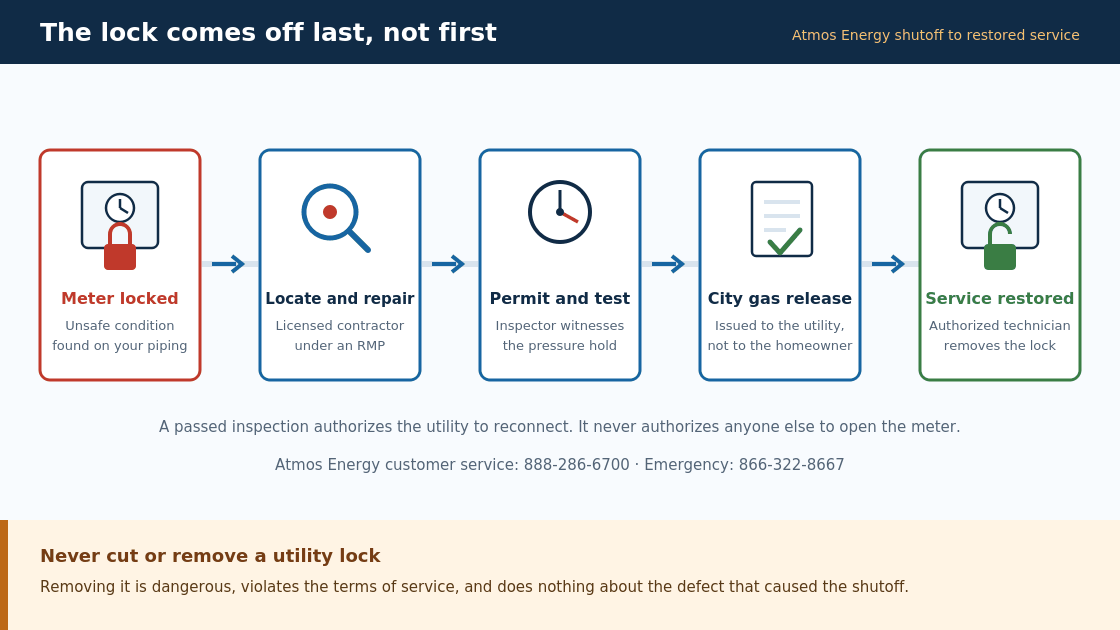
When Atmos Energy concludes that customer-owned piping presents a hazard, it can disconnect service and, in many cases, install a lock or other security device at the meter or shutoff valve so that nobody turns it back on.
That lock is a barrier rather than a fix. Therefore, paying the bill, calling customer service or asking for the lock to come off will not move the process forward while the piping defect is still there.
Instead, the unsafe condition has to be corrected, and the city’s and utility’s restoration requirements have to be satisfied, before reconnection is even on the table.
Never Cut or Remove an Atmos Energy Lock
Only an authorized utility representative removes the utility’s lock and restores service.
A passed pressure test and an approved city inspection authorize the utility to reconnect. However, they never authorize a homeowner or a contractor to operate the meter.
Step by Step: From Gas Leak Detection to Restored Service
For a leak-related shutoff that requires piping repairs and municipal clearance, this is the sequence properties in Southlake, Dallas, Frisco, Allen and Plano typically follow.
Atmos Energy Investigates and Secures the Service
The utility responds to the reported odor or alarm and then determines whether an unsafe condition exists. If it finds one on customer-owned piping, it disconnects and secures the meter.
Meanwhile, hold onto the service notice, red tag or any other paperwork left behind. Usually it names the area where readings were taken, which gives the contractor a starting point and can therefore shorten the gas leak detection phase considerably.
Engage a Licensed Contractor Under a Responsible Master Plumber
Work on customer-owned gas piping goes through a properly licensed plumbing company. In Texas, that company operates under a Responsible Master Plumber, or RMP.
The RMP is the license holder authorized to obtain plumbing permits, and consequently carries responsibility for work performed under that license. Moreover, the RMP may do the work personally or supervise other appropriately licensed or registered personnel as Texas law allows.
If gas leak detection traces the defect inside a furnace or another appliance, then a properly licensed HVAC professional may need to handle that portion.
Perform Professional Gas Leak Detection
The professional evaluates the system and narrows down where gas is escaping. Depending on conditions, that can involve:
- Visual inspection of accessible piping and fittings.
- Inspection of appliance connections and shutoff valves.
- Listed electronic combustible-gas detection equipment.
- Noncorrosive leak-detection solution on accessible joints.
- Controlled pressure testing of isolated sections and branches.
- Tracing and pinpointing of underground piping where required.
A dropping gauge tells you a leak exists. Still, it does not tell you where. Therefore, sectional isolation plus field gas leak detection equipment is what converts “somewhere in the system” into a specific joint or a specific few feet of buried pipe.
Pull the Required City Permit
Where the repair and gas release require a permit, the responsible contractor obtains it from the city having jurisdiction. In effect, the permit creates the record of authorized work and allows the inspection to be scheduled.
Permit category depends on the nature of the repair, the occupancy and the city’s own classifications. Accordingly, a gas piping repair may fall under a plumbing permit, a gas permit or another designation.
Some cities offer limited homeowner permit exemptions. However, those exemptions do not waive gas safety requirements or inspection obligations, and they rarely apply cleanly to a leak-related shutoff.
Because service was disconnected for an unsafe condition, confirm the specific gas-release procedure with both the city and Atmos Energy before work begins.
Repair or Replace the Defective Piping
Scope follows condition. For example, a single failed fitting may need nothing more than a localized repair, whereas a yard line with widespread corrosion may need a full replacement run.
In every case, new pipe and fittings must meet the adopted code, approved installation methods and the manufacturer’s instructions, including any listing requirements for CSST and similar products.
Furthermore, underground and concealed piping inspections happen before the work is covered, unless the building official authorizes something different.
Pressure-Test the Repaired System
With repairs complete, the contractor sets up the test. Usually that means an approved gauge on a test connection on the customer-owned piping near the meter.
Next, the system is isolated from the live utility supply, and any appliance or component not rated for the test pressure is isolated or disconnected as the code requires.
Test pressure is then applied with an approved medium, the pressure source is shut off, and finally the gauge is watched for loss over the required period.
Meanwhile, the city determines pressure, duration, gauge specifications and which portions of the system have to be under test.
In short, the system has to hold to the city’s requirement before it can be approved.
Schedule the Inspection
The permit holder requests the appropriate gas inspection, tied to the property address and permit number. Additionally, when the request is for release of utilities, some cities ask that the provider be identified.
Above all, the contractor is responsible for having the system ready when the inspector arrives: test set, gauge in place, and access provided to appliances and to the work.
The Inspector Witnesses the Test
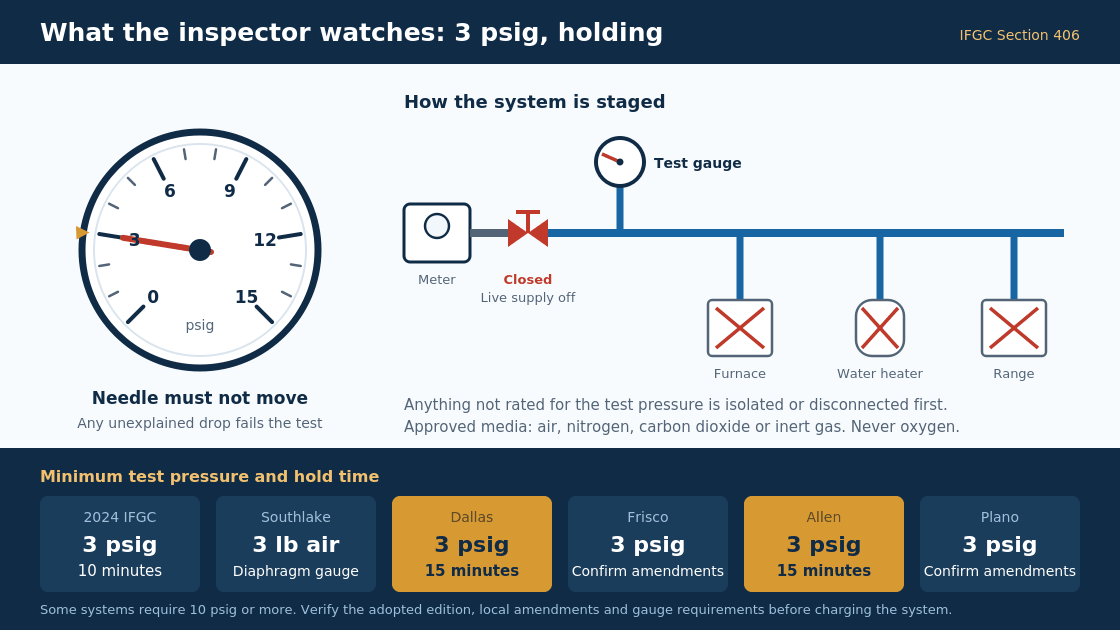
The city plumbing or building inspector reviews the test setup and the repair, checks the pressure-measuring device, and then witnesses the hold.
Typically, a 3 psig test is the baseline for residential low-pressure systems. Nevertheless, a city amendment, a higher operating pressure or a particular piping type can require more pressure or a longer hold.
Pressure has to stay stable for the full period with no evidence of leakage. Otherwise, an unexplained drop, or any other code violation the inspector observes, results in a failed inspection that must be corrected and re-inspected.
A passed test establishes that the tested piping met the requirement at the time of inspection. It is not, however, a warranty on every appliance component or on future operating conditions.
The City Records Approval and Issues the Gas Release
After a successful inspection, the city records the approval. In cities with electronic permitting, that result may subsequently show up in the online permit record.
Where municipal authorization is required for gas service, the city also issues or transmits the gas release to the utility.
This matters because a contractor saying the leak is fixed is not the same thing as an official municipal release. In other words, only the city completes that step.
Atmos Confirms the Release and Schedules Reconnection
The release has to actually reach Atmos Energy. Depending on the municipality, it may travel electronically, sit available in a permitting system, or else be communicated directly by city personnel.
Atmos may then verify the release through municipal approval records or other authorized channels. Of course, the exact mechanism differs from city to city.
Once the clearance is in hand, call Atmos Energy to arrange reconnection. The general customer service number is 888-286-6700.
A passed inspection is a prerequisite rather than a dispatch. Consequently, scheduling and same-day availability remain subject to the utility’s own procedures and workload.
Atmos Unlocks the Meter and Restores Service
Finally, an authorized Atmos technician completes the restoration: lock removed, service restored, utility safety checks performed.
A responsible adult 18 or older needs to be present for the appointment. In addition, the technician needs access to gas appliances inside the home.
Piping and appliance connections are checked for leakage as the adopted fuel-gas code requires when service is restored after an interruption. Afterward, the technician may relight accessible appliances that are in safe working condition.
Never attempt to remove the lock or restore service yourself.
Which Code Governs the Gas Pressure Test?
The International Fuel Gas Code (IFGC) sets requirements for the design, installation, inspection, testing and operation of fuel-gas piping systems. Specifically, the testing provisions live in IFGC Section 406: Inspection, Testing and Purging.
For one- and two-family dwellings governed by the International Residential Code, parallel requirements appear in the residential fuel-gas provisions of Chapter 24.
Each city decides which edition it adopts and whether its amendments change the numbers. As a result, the same repair can face a different test in two cities twenty minutes apart.
Inspection and Pressure Testing
This section establishes that piping installations are inspected and pressure tested before acceptance and initial operation, so that materials, design, fabrication and installation can be verified against the code.
Testing After a Repair
Piping repaired or added to after a pressure test is retested as the code requires.
Additionally, the model code allows an exception for certain minor repairs and additions where the work is inspected and the connections are checked with an approved gas leak detection method.
However, that exception does not override a city or utility requirement for a specific test and gas release after a leak-related shutoff. Those restoration requirements still have to be met.
What the System Can Be Charged With
The model code permits air, nitrogen, carbon dioxide and inert gas as test media.
Oxygen, by contrast, is never used as a gas piping test medium.
Protecting Appliances During the Test
Appliances and components are isolated or disconnected before the test as applicable. Therefore, anything designed for an operating pressure below the test pressure is not subjected to it.
Setting the system up correctly is the licensed professional’s responsibility.
Gauge Requirements
Test pressure is measured with a manometer or an approved pressure-measuring device capable of showing pressure loss over the test period. Moreover, the pressure source must be isolated before the test is evaluated.
Mechanical gauges must meet the code’s requirements, including range limitations. Furthermore, a city may specify diaphragm-gauge type, dial size, increments or current calibration.
How Much Pressure?
Under the unamended 2024 IFGC, test pressure is at least 1.5 times the proposed maximum working pressure, with a minimum of 3 psig.
Adopted edition, local amendments, system operating pressure and the building official determine what is actually required. In particular, certain higher-pressure and welded systems require more.
Therefore, verify the number before charging the system, rather than after the inspector is standing in the driveway.
How Long Must It Hold?
The unamended 2024 IFGC sets a minimum duration of 10 minutes for a single-family dwelling or a system under 10 cubic feet, with volume-based durations for other systems.
Cities commonly adopt longer minimums. For example, Dallas requires a minimum 15-minute witnessed gas-release test. Above all, follow the requirement of the city doing the inspection.
What a Pressure Drop Means
Tested piping has to withstand the test pressure without evidence of leakage or other defects. Consequently, an unexplained reduction points to a leak that must be investigated, corrected and retested before approval.
Approved Gas Leak Detection Methods
The code recognizes approved gas leak detection methods, including listed combustible-gas detectors and noncorrosive leak-detection fluids. Afterward, defective piping is repaired or replaced and the affected piping retested.
Safety Checks When Gas Comes Back On
Before gas enters a new system, piping is checked for open fittings and improperly closed or uncapped outlets. Likewise, when service is restored after an interruption, the system is checked for leakage.
If leakage is found, then the supply is shut off until repairs are completed. Meanwhile, appliances stay out of operation until the required leakage checks, purging and connection checks are done.
Other Code Sections That Come Into Play
Holding a test is necessary but not sufficient. Depending on where the defect is and how much piping gets replaced, these provisions may also apply.
| Code reference | Subject | Why it matters in a leak repair |
|---|---|---|
| IFGC 401 | General piping requirements | Sets the scope of what governs the system. |
| IFGC 402 | Design and sizing | Applies when replacement piping has to supply the connected appliance load. |
| IFGC 403 | Piping materials | Governs acceptable pipe, fittings and components. |
| IFGC 404.1–404.2 | Installation and CSST | Covers proper installation, listing and manufacturer requirements. |
| IFGC 404.5 | Concealed fittings | Limits which fitting types are permitted in concealed locations. |
| IFGC 404.11 | Corrosion protection | Central to any buried metallic yard line replacement. |
| IFGC 404.12 | Burial depth | Sets minimum cover, subject to local amendments. |
| IFGC 404.14 | Piping beneath buildings | Restricts and requires protection for pipe run under a structure. |
| IFGC 404.15 | Unused outlets | Requires abandoned outlets to be properly sealed, subject to exceptions. |
| IFGC 406.1–406.7 | Inspection, testing and purging | The core of the pressure test, gas leak detection checks and purge procedure. |
| IFGC 408.4 | Sediment traps | Frequently cited at appliance connections during inspection. |
| IFGC 409 | Shutoff valves | Governs valve installation and accessibility. |
| IFGC 410 | Pressure regulators | Applies where regulators or pressure controls are involved. |
| IFGC 411 | Appliance connections | Governs approved connections between piping and appliances. |
These references describe the 2024 model International Fuel Gas Code. However, the adopted edition, corresponding residential provisions, local amendments and manufacturer instructions control the actual work.
City by City: Southlake, Dallas, Frisco, Allen and Plano
These five cities share most of their gas safety framework, though not their adopted editions or their amendments. In particular, that difference shows up in test pressure, test duration and gauge requirements.
| City | Published fuel-gas code | Test and inspection notes |
|---|---|---|
| Southlake | 2021 IFGC with local amendments. | Published residential inspection guidance specifies a 3 lb air test on a diaphragm gauge for gas rough-in and meter-release inspections. Therefore, confirm duration, gauge requirements and the release procedure with Building Inspections. |
| Dallas | 2021 IFGC with Dallas amendments. | Publishes a gas-restoration requirement of 3 psig witnessed by a city plumbing inspector for at least 15 minutes, covering piping from the meter, yard service and structures. |
| Frisco | 2024 IFGC with local amendments, effective March 1, 2026. | The unamended model code sets a 3 psig minimum and a 10-minute minimum for single-family dwellings. Still, confirm Frisco’s amendments, permit requirements and inspection instructions before testing. |
| Allen | 2021 IFGC with local amendments. | Published amendments specify a minimum 3 psig test for ordinary applications and at least 10 psig for certain systems, with a residential test duration of at least 15 minutes, subject to the code official’s authority. |
| Plano | 2024 IFGC with local amendments, adopted under Ordinance 2025-6-9. | The unamended model code provides a 3 psig minimum and a 10-minute minimum for single-family dwellings. Nevertheless, confirm Plano’s amendments, inspection requirements and gas-release procedure before testing. |
Code information reviewed September 2026. In short, this table is a general reference, not authorization to apply the same pressure, duration or procedure on every project.
Southlake
Southlake Building Inspections administers building and trade permits. Therefore, for repairs requiring a permit and a gas release, confirm the inspection category and testing procedure before scheduling.
Building Inspections: 817-748-8236
Southlake Building Codes and Amendments
Southlake Permits and Inspections
Dallas
Dallas publishes procedures for gas testing and restoration of service. After the required inspection passes, the city issues the gas release to Atmos Energy.
Plumbing and Mechanical Inspections: 214-948-4480
Dallas Gas Test Guidelines and Gas Release Requirements
Frisco
Frisco contractors follow the city’s permitting and inspection procedures for gas piping work. In addition, when requesting an inspection for release of utilities, the city’s published instructions call for identifying the utility provider, such as Atmos Energy.
Building Inspections: 972-292-5301
Frisco Adopted Building and Fuel-Gas Codes
Frisco Building Inspection Procedures
Allen
Allen has adopted local fuel-gas amendments addressing pressure testing, gauge specifications and related requirements. Therefore, verify the inspection category and gas-release instructions before scheduling.
Allen Land Development Code — Building Regulations
Plano Gas Leak Detection and Permits
Plano adopted the 2024 International Fuel Gas Code with local amendments. Consequently, repairs requiring permits and inspections must comply with the city’s adopted codes, amendments and Building Inspections procedures.
Meanwhile, homeowners dealing with a suspected leak in Plano can start with our Plano, TX leak detection services page, which covers slab, pool, water and gas leak detection throughout the city.
How Does Atmos Know the Inspection Passed?
This is the question homeowners ask most often once the plumber packs up. In short, the city tells them, though the method varies.
When the inspection passes, the municipality records the result in its permitting or inspection system and then completes its utility gas-release process. Accordingly, Atmos may receive that release electronically, verify it through an authorized permitting system, or get it directly from city personnel.
The release exists to confirm that the municipality has authorized the gas connection or reconnection.
For example, the City of Dallas states that its plumbing inspector contacts Atmos Energy and provides the gas release once the inspection is approved. The homeowner then calls Atmos to arrange the meter reconnection.
Still, do not assume a passed inspection creates an appointment on its own. Instead, confirm with the city that the release went out, and then call Atmos to confirm it was received and to get on the schedule.
Who Pays for the Repair?
Generally, it depends on which side of the point of delivery the defect sits.
Atmos Energy is responsible for its utility-owned distribution facilities and service equipment, including the meter.
By contrast, the property owner is generally responsible for customer-owned piping downstream of the point of delivery. Typically that includes lines feeding the house, detached structures, pool heaters, outdoor kitchens and other gas equipment on the property.
A licensed plumbing contractor handles gas leak detection and repair on customer-owned piping. However, if the suspected leak involves the utility’s service line, the meter or other utility-controlled equipment, then Atmos has to investigate it.
When ownership is unclear, confirm the point of responsibility with the utility before scheduling repairs.
Frequently Asked Questions About Gas Leak Detection
Can I cut the lock off my Atmos gas meter?
No. Under no circumstances should you remove a utility lock or attempt to restore service at a secured meter. Only an authorized utility technician completes the reconnection.
Do I need a Responsible Master Plumber to get my gas back on?
For customer-owned piping repairs that require a licensed plumbing contractor, use a company operating under a Texas Responsible Master Plumber. The RMP is responsible for work performed under that license, and other appropriately licensed or registered personnel may work under the supervision Texas law allows.
In addition, city permit, inspection and utility-release requirements apply on top of that.
Does every gas repair require a permit?
It depends on the work, the city and the circumstances of the shutoff. Usually, minor appliance-related work is handled differently from piping replacement or a full restoration requiring a municipal gas release.
Therefore, if Atmos shut off service because of a leak, confirm the requirements before repairs begin rather than after.
What pressure does a residential gas line have to hold?
The unamended 2024 IFGC generally requires a minimum 3 psig test, with higher pressures for certain systems. However, the city having jurisdiction may require something different, so the contractor verifies pressure, gauge, duration and isolation procedure against local amendments.
How long does the inspection take?
The hold time is only one piece. Besides that, scheduling, property access, review of the repair, appliance checks and any corrections all factor into the overall timeline. For instance, Dallas requires its gas-release test to be witnessed for at least 15 minutes.
Can Atmos restore service the same day?
Sometimes, though it is not guaranteed. Repairs, city approval, the gas release, utility scheduling and safety checks all come first. Therefore, call Atmos once the municipal clearance is issued to find out the next available appointment.
My plumber fixed the leak. Isn’t that enough?
The repair is a major step, but usually not the last one. Where a city gas release is required, the inspection must be approved and the release communicated to Atmos, which then completes its own reconnection and safety procedures.
What happens if the pressure test fails?
An unexplained pressure loss means additional leakage or another defect is present. Consequently, the contractor repeats gas leak detection, corrects the cause, and then obtains the required test and inspection approval before the city issues the release.
Does Atmos repair every gas leak?
Atmos investigates suspected leaks and is responsible for its utility-owned facilities. By contrast, repairs to customer-owned piping are generally the property owner’s responsibility and are performed by a qualified licensed contractor.
Getting Gas Back On, Safely
A leak-related shutoff takes out heat, hot water, cooking and whatever else runs on gas, usually with no warning. Naturally, the instinct to get it fixed fast is the right one, as long as the sequence is respected.
First, correct the unsafe condition. Then work the permit, repair, pressure test, inspection and gas release in order. Otherwise, skipping ahead or touching the utility’s lock only adds delay and risk.
Above all, working with a gas leak detection contractor who already knows how each city handles test pressure, gauge requirements and utility release is the difference between one inspection trip and three.
Need Gas Leak Detection in Southlake, Dallas, Frisco, Allen or Plano?
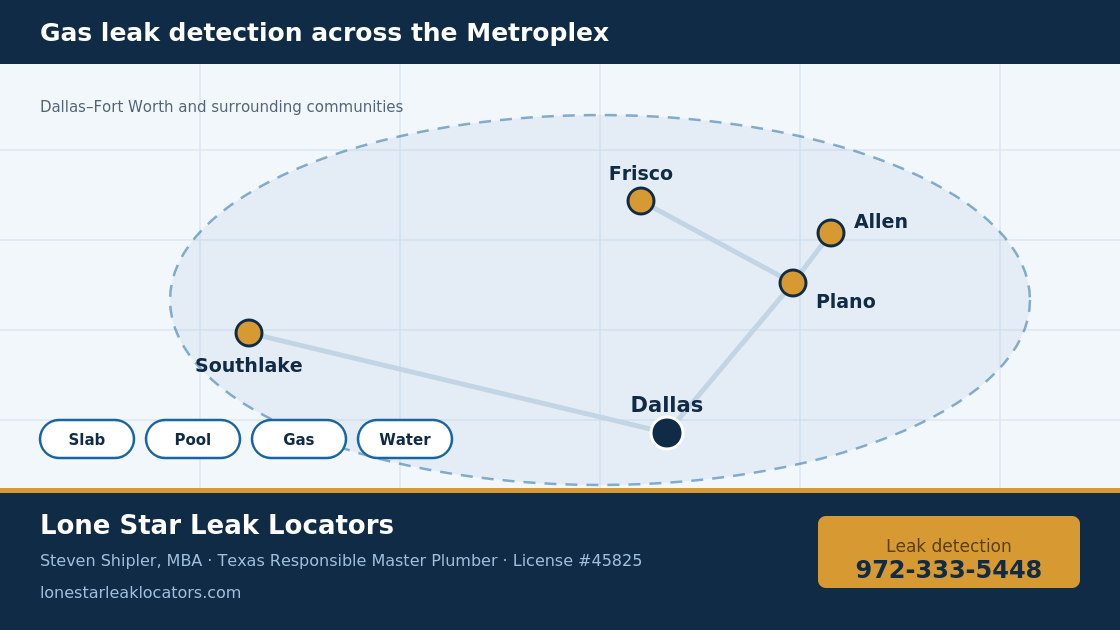
Lone Star Leak Locators provides professional gas leak detection and location across the Dallas–Fort Worth area. In short, we help property owners pinpoint the problem and understand the path back to safe service.
Slab • Pool • Gas • Water Leak Detection
In Plano? See our Plano leak detection services .
Steven Shipler, MBA
Texas Responsible Master Plumber
License #45825
Call 972-333-5448 Visit Lone Star Leak Locators
For a suspected active leak, leave the area and contact 911 and Atmos Energy at 866-322-8667 from a safe location before requesting routine service.
Code, Utility and City References
Finally, these sources cover gas piping safety, testing, local requirements and service restoration.
- International Code Council — 2024 International Fuel Gas Code, Chapter 4
- Atmos Energy — Gas Service Restoration After Repairs
- Atmos Energy — Natural Gas Leak Detection and Safety
- City of Dallas — Gas Test Guidelines
- City of Southlake — Adopted Building Codes
- City of Frisco — Adopted Codes
- City of Allen — Building Regulations and Fuel-Gas Amendments
- City of Plano — Building Codes and Ordinances
- Texas State Board of Plumbing Examiners
- Lone Star Leak Locators — Plano, TX Slab, Pool, Water and Gas Leak Detection
Educational information only. Applicable codes, municipal amendments, permitting procedures and utility restoration requirements must be verified for the specific property and scope of work.