

Lone Star Leak Locators Case Study
How to Find a Swimming Pool Leak in Plano, Allen and Collin County
Written by Steven Shipler, Texas Licensed Master Plumber and Responsible Master Plumber, Texas License #45825.
A swimming pool leak can waste water, increase utility bills, damage soil beneath the pool deck, strain pool equipment, and create expensive structural problems. The challenge is not simply proving that water is disappearing. The real challenge is identifying where the water is escaping before unnecessary concrete, decking, landscaping, or plumbing is removed.
“`Pool Leak Detection in North Texas
Test the Pool Before Breaking Concrete
Lone Star Leak Locators isolates, pressure tests, evaluates, and helps locate hidden swimming pool plumbing leaks throughout Plano, Allen, and Collin County.
Call 972-333-5448 “`The best pool leak investigation follows a process: confirm the water loss, inspect the visible system, isolate the plumbing, pressure test each line, narrow down the suspected area, and explain the evidence before repairs begin.
“`Step 1: Confirm That the Pool Is Actually Losing Water
Swimming pools naturally lose some water through evaporation, splashing, backwashing, wind, and swimmer activity. Before diagnosing an underground plumbing leak, the first step is to determine whether the water loss appears abnormal.
A basic bucket test may help compare pool water loss with normal evaporation.
- Fill a bucket with pool water.
- Place the bucket on a pool step so it remains stable.
- Mark the water level inside the bucket.
- Mark the pool water level outside the bucket.
- Operate the pool normally for a set period.
- Compare the water-level changes.
If the pool drops noticeably more than the water inside the bucket, the pool may have abnormal water loss.
A bucket test can suggest that a leak exists, but it does not identify whether the leak is in the pool structure, equipment, fitting, or underground plumbing.
“`Step 2: Inspect the Pool and Equipment
The next step is a thorough visual inspection of the visible pool system.
Areas that should be checked may include:
- Pool pumps
- Filters
- Heaters
- Chlorinators
- Valves and unions
- Pump seals and drain plugs
- Visible pipes and fittings
- Skimmers
- Return fittings
- Pool lights and niches
- Main drains
- Tile lines
- Expansion joints
- Cracks in plaster or the pool shell
- Wet soil near the equipment pad
- Settling or erosion near the pool deck
A visible equipment leak may only occur while the pump is operating. Other leaks may occur when the system is off. Observing the pool under different operating conditions can provide useful evidence.
Step 3: Determine Whether Water Loss Changes With the Pump
Comparing water loss while the pool equipment is running and while it is off may help narrow down the type of leak.
| Observation | What It May Suggest | Possible Next Step |
|---|---|---|
| More water loss while pump runs | Possible return-side or pressurized plumbing leak | Isolate and pressure test return lines |
| More water loss while pump is off | Possible suction-side, shell, fitting, or static leak | Inspect fittings and isolate suction lines |
| Water stops dropping at one elevation | Possible leak near a fitting, skimmer, light, return, or crack at that level | Inspect and dye test that elevation |
| Air enters the pump basket | Possible suction-side leak or equipment issue | Inspect valves, fittings, pump lid and suction lines |
These observations help guide the investigation, but they do not replace proper isolation and pressure testing.
Step 4: Dye Test Suspected Pool Openings
Dye testing may help identify water movement near suspected cracks, skimmers, return fittings, light niches, main drains, tile joints, or other pool penetrations.
The water should be calm during the test. A small amount of dye is released close to the suspected area. If the dye is drawn directly into an opening, that may indicate active water movement.
Dye testing is useful for shell and fitting leaks, but it does not fully evaluate underground plumbing lines.
Step 5: Isolate the Pool Plumbing Lines
If the visual and dye inspections do not identify the source, the pool plumbing may need to be isolated.
Individual plumbing branches may include:
- Skimmer suction lines
- Main drain lines
- Return lines
- Cleaner lines
- Spa suction lines
- Spa return lines
- Waterfall or water-feature lines
- Dedicated circulation lines
Isolation allows each section to be evaluated separately instead of testing the entire pool system as one large group.
Why Line Isolation Matters
Without proper isolation, pressure loss may be blamed on the wrong pipe. A leaking test plug, open valve, shared branch, equipment connection, or improperly separated line can produce confusing results.
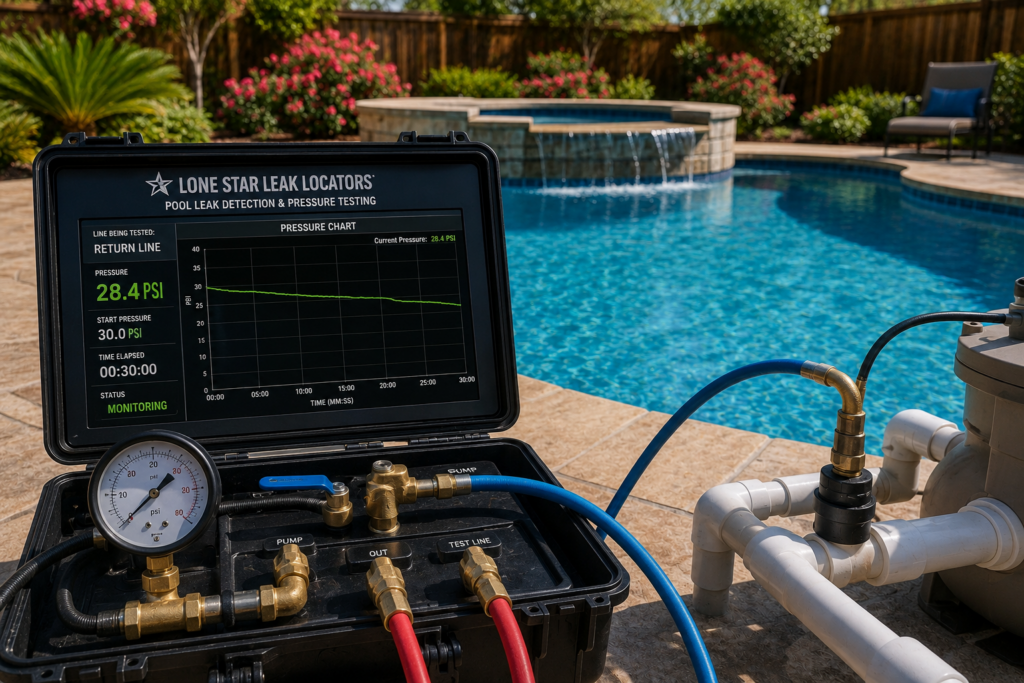
“`Step 6: Pressure Test Each Pool Plumbing Line
Pressure testing is used to determine whether an isolated plumbing line can hold controlled pressure.
A properly isolated line is filled and tested under conditions appropriate for the pipe and system. The pressure is then observed for a period of time.
The results may show:
- The line holds pressure
- The line slowly loses pressure
- The line loses pressure quickly
- The test cannot be completed because isolation is incomplete
- A valve, fitting, plug, or accessible connection is leaking
A line that loses pressure may contain a leak, but the pressure test usually identifies the affected line rather than the exact underground repair spot.
Improper pressure testing can damage fittings, plumbing, valves, or pool equipment. Testing should be performed by someone who understands the system and the safe limitations of the components.
“`Step 7: Locate the Suspected Underground Leak
Once a specific plumbing line is identified as leaking, additional methods may be used to narrow down the suspected location.
Depending on site conditions, the process may involve:
- Acoustic listening equipment
- Air and water testing
- Tracer-gas methods
- Electronic locating
- Reviewing the probable pipe route
- Listening near deck joints and penetrations
- Checking for wet or eroded soil
- Comparing deck movement with the suspected line path
- Selective exploratory access when necessary
Underground pool plumbing may run beneath concrete, landscaping, retaining walls, outdoor kitchens, patios, decks, or other improvements. The repair location should be based on evidence rather than convenience.
Step 8: Have a Master Plumber Interpret the Results
Leak-detection equipment provides information. It does not replace professional judgment.
Steven Shipler is a Texas Licensed Master Plumber and Responsible Master Plumber, Texas License #45825. That experience matters when interpreting pool pressure-testing results and recommending a repair.
A Master Plumber understands:
- Pressure and flow
- Pipe materials
- Valves and fittings
- Plumbing isolation
- Testing procedures
- Underground pipe routing
- Repair methods
- Excavation concerns
- Connections between pool and property plumbing
- Whether a proposed repair matches the evidence
Pool Plumbing Is Still Plumbing
Have the results reviewed by Steven Shipler, Texas Licensed Master Plumber and Responsible Master Plumber, Texas License #45825.
Request Pool Leak Testing “`Common Pool Leak Findings
| Finding | What It May Mean | Possible Response |
|---|---|---|
| Return line loses pressure | Leak may be in a pressurized return branch | Locate line and narrow suspected repair area |
| Skimmer line loses pressure | Suction plumbing or skimmer connection may be leaking | Evaluate skimmer throat, fitting and underground route |
| All plumbing holds | Leak may be in shell, fitting, equipment, evaporation or another component | Continue structural, equipment and dye testing |
| Leak near equipment pad | Possible seal, valve, union, filter or equipment connection leak | Repair accessible component and retest |
| Water stops at light elevation | Possible light niche or conduit leak | Inspect and dye test the light assembly |
Why Pool Leaks Are Common in Plano, Allen and Collin County
North Texas swimming pools are exposed to heat, drought, heavy rain, expansive clay soil, soil movement, and foundation or deck settlement. These conditions can place stress on underground pipes, pool shells, fittings, equipment connections, and surrounding concrete.
Pool leak problems in Collin County may involve:
- Soil expansion and contraction
- Deck movement
- Pool-shell cracking
- Shifted underground fittings
- Broken PVC pool plumbing
- Leaks near skimmers or returns
- Equipment deterioration
- Previous repairs that did not address the actual source
The city may change from Plano to Allen, McKinney, Frisco, Murphy, Lucas, Fairview, Wylie, or another Collin County community. The basic rule remains the same: test before excavating.
Mistakes to Avoid When Searching for a Pool Leak
- Assuming every water loss problem is evaporation
- Replacing the pump without testing the plumbing
- Breaking concrete based only on a wet area
- Testing multiple lines together without proper isolation
- Using excessive test pressure
- Ignoring leaks that only occur while equipment runs
- Assuming a failed line identifies the exact repair location
- Repairing a visible crack without confirming whether another leak exists
- Hiring someone who cannot explain the test results
- Approving major work without written findings
What a Professional Pool Leak Evaluation Should Tell You
At the end of a professional pool leak investigation, the property owner should understand:
- Whether abnormal water loss was confirmed
- Which parts of the pool were visually inspected
- Which lines were isolated
- Which lines held pressure
- Which lines lost pressure
- Whether the likely issue is structural, equipment-related, or plumbing-related
- The approximate suspected leak area
- Whether additional locating is recommended
- Whether concrete or excavation may be required
- Which repair option best matches the evidence
Master Plumber Credentials
Lone Star Leak Locators places strong emphasis on professional plumbing knowledge and proper interpretation of test results.
Steven Shipler
Texas Licensed Master Plumber
Responsible Master Plumber
Texas License #45825
Finding a pool leak requires more than owning pressure gauges or listening equipment. It requires understanding how the plumbing system is constructed, how the lines interact, how to isolate them, how to safely test them, and how to translate the results into a reasonable repair plan.
“`Frequently Asked Questions
How can I tell whether my pool is leaking or evaporating?
A bucket test can compare pool water loss with normal evaporation. If the pool level drops more than the water inside the bucket, additional leak testing may be needed.
Can pressure testing find a swimming pool leak?
Pressure testing can help identify which isolated plumbing line is leaking. Additional acoustic, tracer, electronic, visual, or locating methods may be needed to determine the exact repair area.
Should the pool equipment be inspected first?
Yes. Pumps, filters, heaters, valves, seals, unions, drain plugs, and exposed fittings should be evaluated before assuming the leak is underground.
Does a failed pressure test show exactly where to break concrete?
No. A failed pressure test may identify the leaking line, but the exact underground location usually requires additional evidence and locating work.
Why should a Master Plumber review the pool leak results?
A Master Plumber understands pressure, isolation, pipe materials, fittings, plumbing design, testing, repairs, and safe installation. This helps ensure the results are interpreted correctly before expensive work is approved.
Do you provide pool leak detection in Plano and Allen?
Lone Star Leak Locators provides swimming pool leak detection and pressure-testing services in Plano, Allen, and surrounding Collin County communities. Service availability should be confirmed when scheduling.
Schedule Swimming Pool Leak Detection
If your pool is losing water in Plano, Allen, or Collin County, stop guessing. Have the pool inspected, the plumbing isolated, the lines pressure tested, and the findings reviewed by a Texas Licensed Master Plumber.
Call Now: 972-333-5448Lone Star Leak Locators — Slab, Pool, Gas and Water Leak Detection
“`